As I enter this happy season of launching my new book, my heart and thoughts also travel to two people I was close to who died over the summer. This is truly a “textured time,” as a poet friend of mine likes to say. For those of you who have already read the book—and told me you were sorry to see it end!—here is one story that begins where the book leaves off. For the past five years Wendy has been teaching me about the intimacy of earth and spirit.
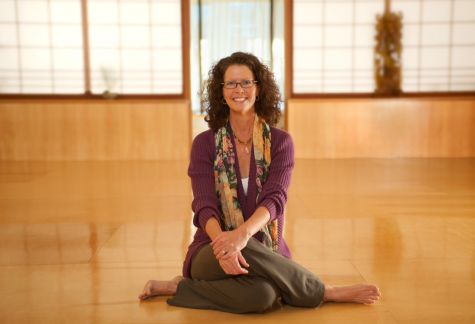
Wendy Bramlett in Studio Be, Boulder, December 2011. Photo by Russell Bramlett.
I walk into Wendy Bramlett’s Saturday morning class at Studio Be, pick up a mat, and choose a spot at the far corner, in the shadows. Here I can turn my face to the wall and let the tears come, if they do.
I am brand-new in town, and I am grieving. Just days ago, during my cross-country move, I learned that my older brother, fifty-five, is dying of colon cancer. He has smoked for years, lived hard, and for much of his life he ate nothing but junk. When I’m not tearful, I am furious. How could he be so heedless of his body? Of the others who love him and depend on him?
Class begins. We stretch out on our backs on the floor.
“Offering your weight generously to the earth, the earth generously supporting your weight.” Her voice is still and steady, a lilt of cheer rippling just below the calm. “There is a fine intimacy between your body and the earth.”
Intimacy. Now there’s a word you rarely hear in a yoga class. Funny thing, too, when yoga is all about bringing body and mind into connection. Yoga—yolk.
Oh, no, thinking. I catch myself and return to the room.
“Be very deliberate in how your body meets the earth.” Her voice also is deliberate. “Be aware of each point of contact.”
My attention is carried to my back, feeling the pressure between vertebrae and floor.
“If the vertebrae contact the earth beneath them with consciousness and care, they will be more receptive to gravity.”
Being receptive. My breath responds, slowing and deepening. Around me, the pre-class bustle has completely quieted, each body now receiving the words, receiving the earth.
“Our bodies are most harmonious with gravity when we are lying on our back.”
Barely five minutes into class, and already I have softened, my body opening, my mind carried by a flow of words fresh as springwater.
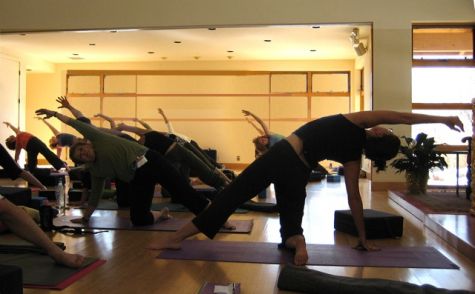
Wendy in class. Photo courtesy Ellen Gager.
We practice on our knees on the mat, extending one leg and arm, then the other. Her voice traces connections between the movements in our bodies and the earth. The link is breath.
“Between the earth and your body, an exchange of breath, a flow of recognition. The breath and gravity are old friends.”
Something in me wakes up, softly astonished. Of course, how simple—body and earth. Each body here, on its mat on the floor. The larger body of us all, earth. And flowing between them, the breath. Gravity hugging us to earth, dependable and involuntary as breath.
“Let the earth breathe you, soften you.”
A small release between my ribs, and the tears begin. I turn my face to the wall and reach for the tissue stowed next to my mat.
For most of a year it is like this. Through my brother’s death, through the months after, I show up in Wendy’s class, tissue in hand. Always she leads me back to the body, back to earth. In almost every class, I turn my face to the wall for a few moments. But I keep coming back.
Is it the flow of words, clear as water? Or the tone of her voice, fresh as a cool cloth on heated brow?
For whatever reason, though the yoga choices in Boulder are profuse, I never visit another studio.
On our backs, our hands stretching overhead. One knee is bent, the sole of that foot meeting the other thigh.
“Vrksasana. Tree pose. We can experience it on the floor, fully supported. Feel the clarity in the hip joint, the breath moving freely through the hip because it receives the affirmation of the ground. . . . The earth is reliable. Avail yourself of its support.”
When, after a series of stretching poses on our knees, we finally rise for a vertical vrksasana, she calls attention again to the hip.
“The standing leg is strong, but without extra effort in the hip. Remember how it felt on the mat? The breath can move with just as much clarity through the hip now that we are balancing on that leg.”
Our minds follow the interior streams, our eyes finding a still place on the floor before us. Her voice flows on. “The standing leg full of appreciation for the earth beneath it. The sole of the foot firmly grounded, and the hands reaching skyward . . . Receiving the dual input of both earth and air, ground and space.”
I have never heard so much talk of the earth in a yoga class. As if, for her, nature and yoga are not separate.
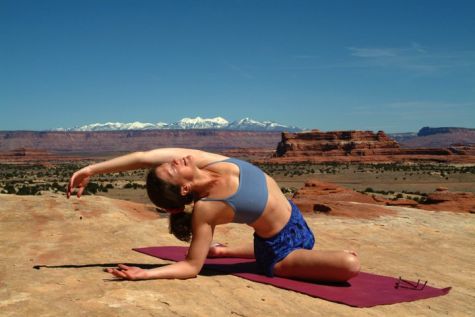
Photo by Russell Bramlett.
It fits well with the work I am doing, writing a book about our relationship to earth. After class I approach her. I want to get to know her, share this passion for earth. When she hears I am working on a book, her eyes light with interest. We chat a few moments about breath and earth—so close, even in the letters of the words. Her gaze rests lightly on me, though her attention is full, complete. Amid the buzz of the departing class, she gives me the feeling that I am the only person in the room.
“Oh, I can’t wait to read your book!” she says when we part. I can’t either. So many things I want to talk over with her!
In class we are working on a twisty pose, revolving triangle, parivrtta trikonasana. Though I’ve been practicing for years, this posture remains precarious. I’ve never yet managed to keep my balance in it.
Bending, breathing, we make our way carefully toward the pose. One foot behind the other. Bending, breathing. Then, hands on blocks, a slow twist, one hand moving to the hip. Wendy invites our spines to open a little further.
“Listen to the callings of the spine. The body doesn’t seek discomfort. The body seeks ease and balance. . . . Move in harmony with your body, not in argument.”
I’ve been arguing with my body about this pose for a long time.
Suddenly I find a new avenue of breath, a tiny opening. Lifted by the breath, my shoulder rises. Within my heart a new feeling of ease. More room.
“Let the breath be generous in the upper chest. . . . Watch how the breath moves your body, how generously it creates space within your body. The breath is enormously generous, as generous as the body allows.”
Then my hand reaches upward, stretches toward the ceiling. I am in revolving triangle. And I am breathing. Still breathing.
Invitation, not effort. A laying down of arms against the body.
“Wendy believes in the essential innocence of the body,” a close friend of hers tells me. “In the natural intelligence within each of us. Sometimes we practice a kind of fascism toward the body—it’s all about discipline, shaping, forcing. Wendy sees that the body can do its own healing. She would say, when we get out of our own way, the body knows how to self-organize. And all we have to do, really, is recognize the truth of what’s going on inside.”

Wendy exploring a pose. Photo courtesy Ellen Gager.
“What would you like to work on today?” Wendy asks at the beginning of class. Responses come from various directions. “Shoulders.” “Hips.” “Upper back.”
“Upper back? Oh, that’s a good one. We can work on that.”
Wendy has not outlined a plan for today’s class. Instead, she is listening for what wants to happen. During class she is attentive to what unfolds in the moment. As if the surest foundation for life is none at all, just listening. Simply listening.
“I sometimes hear myself saying things I haven’t consciously thought about,” she confesses one day. “And I wonder, Is that in the yoga texts? And I go home and check the sutras, and sure enough, it’s there. It amazes me—thousands of years ago they were putting into words the things we still experience in our bodies.”
In each pose, the alignment she encourages us to find has nothing to do with how the pose appears. No words from her about straightening an arm or leg or stretching to our edge. Instead, she eases us away from the edge so that breath can flow, so that we can receive what wants to happen. She is taking us into the heart of the pose, deep into the tissues of the body, the place where breath and cells are joined, where movement arises.
“Listen to the sensations,” she says when we are tangled into gomukhasana, cow-face pose, knees stacked one on top of the other, hips screaming with the unfamiliarity of it. “Sensations are the language of the body.”
One elbow is lifted toward the sky, the other reaching toward earth, hands behind the back and fingertips making their ways toward the exact place where, in the upper back, so many of us carry so much tension.
“There is room for discussion in the body,” Wendy says.
“My shoulders are sure talking to me!” retorts a student at the far end. Many chuckles around the room. We all just want her to release us from this pose.
Instead, she draws us with her voice deeper into our bodies until we have witnessed, fully witnessed, the process taking place within. “There is room in the body for a conversation you can listen to,” she says.
“The wisdom is in the listening.”
Wendy is famous for holding poses longer than her students. She has been uncommonly strong her whole life. During college, when she discovered yoga in Austin, she would often bike from her home to Barton Springs to practice for a couple hours under the pecan trees above the pool, then swim for an hour in the chilly waters of the spring-fed pool, then bike to campus, attend classes, then head to work, arriving home at 2:00 a.m. And the next morning begin again. “At twenty she could easily wrestle and pin her six-foot-two brother,” her husband, Russell Bramlett, says. “We called her Bam-Bam.”
Wendy’s wit too is wickedly strong. Picking up props after class one day, she stows a strap in the closet. “That’s my strap,” calls a student.
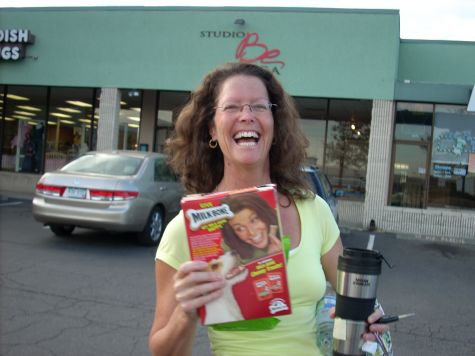
Photo by Bonnie Schwab.
“I haven’t bought a prop yet,” she laughs. “I just collect the props my students bring to class.”
During class one day, with students lying on the floor, a block below each sacrum, another under the spine, she invites all to raise their legs skyward.
“Wendy, what are we doing?” comes a voice on a mat near the door.
“Isn’t it obvious?” she responds. “I have no idea!”
For five years I attend Wendy’s Saturday morning class—sporadically toward the end as the book writing intensifies. I can’t wait to be done with the writing. Most of it took place during the years I have known her. I look forward to finally sitting down with her, getting acquainted with her, talking over with her what it’s like to seek out words for experiences that seem so indescribable.
But then, just a few weeks after the manuscript is done, I hear that Wendy is leaving teaching for a while. She needs to focus on healing. She was diagnosed in early January with cancer. A mass on her liver, late stage 4.
Her students are stunned. When we last saw her, she was the picture of radiant health.
Undergoing chemo does not arrest the disease.
In the spring, she is asked to record an audiofile of a yoga class so it will be available in the future. “I have nothing left to teach,” Wendy responds. “In fact, there is nothing left within me for teaching. Just an open, complete emptiness.”
On June 15 I am scheduled to leave the country to attend a conference. In the week leading up to the trip, I hear that Wendy is moving toward death.
The day before leaving, I spend time in meditation. It is like attending a birth—waiting, watching, breathing. In the waiting, time shifts—away from minutes and hours and toward simple presence. Threshold time. The air feels charged with beginning and ending.
Wendy is drawing away from us.
That night in Houston I miss my connection and am stranded for twenty-four hours in an airport hotel isolated among freeways. The next afternoon I take out my yoga mat and practice. For a break, I walk once around the hotel. And there, in the parking lot, Bootsie the Clown’s van advertises “Laughter, Yoga, Ho Ho Ha Ha Ha.” Wendy would love it. I swear I can hear her laughing.
Walking inside to check email, I learn that Wendy passed away a few hours ago.

Bootsie the Clown van, Houston.
At a small grief gathering some days later at Studio Be, the faces around the room are shell-shocked. What do we do with such a loss? It is immense, far bigger than any of us can say.
The woman leading the ritual invites us to place ourselves in a continuum according to how close we felt to Wendy. We cluster like piglets near the head of the line. Whether or not we knew Wendy outside of class, all of us felt close to her. Several say, “Whenever I talked with her, she made me feel like there was no one else but me.” Heads nod. Later her husband tells me, “She believed healing takes place when the person is seen clearly. Everyone really just needs to be seen.”
At the end of the ritual I have one final question. “What kind of cancer did Wendy have?” I am expecting “liver” or “pancreatic,” the kinds that take people quickly before they have a chance to respond.
“Colon cancer,” I hear. “Metastasized before there were symptoms.”
For a moment the room disappears. I blink hard to get it back. The same cancer my brother had five years ago when I arrived in Wendy’s studio, the cancer he died from at the age I am now. How can this be—colon cancer in Wendy, a woman whose life was defined by listening, who paid exquisite attention to the whispers of her own body? In my brother it made sense, but in Wendy?
Instantly I see the truth: I have been wielding a sword of judgment against my brother. As if by blaming him for getting sick, I could stave off the thing that took his life.
My weapon is made of cardboard. My tidy conclusions about the world will have to go. Even in death, Wendy teaches a more generous way: it is time to lay down arms against my brother.
I am having drinks with a few business associates, talking about my book about to be released. The marketers among us are revving up. These women are wizards at their trade—amassing readers, calculating returns.
“So here’s what you do,” says one, brisk and efficient. Target readers, churn out words, get results. It sounds like an assembly line, machine roaring at full speed.
“But I don’t write that way,” I stammer, aghast.
“Then get someone to do it for you,” she shoots back, supremely confident.
Made-to-order writing? The book was made instead by listening.
How can I explain that the algorithms of the body start with emptiness? That words cannot heal unless they arise from the heart? That writing, to be generous, begins in letting go?
We are on our backs in savasana, the pose of the corpse. At the end of class, after the releasing we practiced in each pose, here is the chance to let go for real.
“Listening in the silence to how your body wants to release.” Wendy’s voice flows through the quiet. “Let the earth move into the body, the body expand into the earth, so that each can replenish the other. . . . Savasana is a reunion with the earth.”
Around the room, all is calm. The busy minds we dragged into class have quieted, slowing to the pace of the body, the pace of earth. The breath of each one is even and deep. From two mats away I hear the beginning of a snore.
“Not extracting ourselves, but connecting to the earth, the source of our vitality. Feel the nourishment of the ground.”
Beneath us, a sure embrace. Within us, not solidity but something more generous: spaciousness. More room, a little more trusting of the breath. Our only foundation the act of opening. Continually opening.
“When you’re ready, come to sit. Let’s breathe together for a few moments.” Her voice is barely audible, sliding gently between our breaths.
In a few minutes we will walk out of this studio; in a few hours or days we will likely again feel tangled in the knots of living. But in these moments, palms together, we breathe. Grateful, serene.
“Namaste,” she whispers.
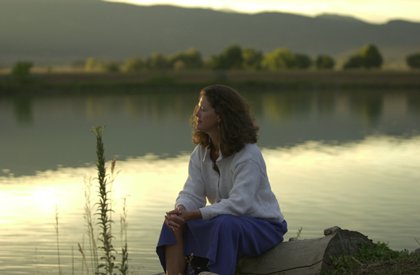
Wendy Bramlett, 1960–2012. Photo by Russell Bramlett.
Thanks to Russell Bramlett for photos and conversation and to Bonnie Schwab and Ellen Gager for photos. I am grateful that Avril Bright kept a record of Wendy quotes; most of those here, including the stories of humor, come from her. And of course we are grateful to Wendy. And to the earth.
A memorial service for Wendy will be held beside the St. Vrain River in Lyons on September 16. For more information, use the contact info on the Studio Be website.
A shorter version of this essay titled “The Gift of Generosity” appears in the Summer 2013 issue of Yoga Internationalmagazine.