A settling torch

Today is Malala Day, the birthday of Malala Yousafzai, the young woman shot in the head for defying the Taliban and daring to work for girls’ access to education. Tweet with the hashtag #StrongerThan to show support for girls’ education and for Malala’s clear, peaceful way of being. Malala says, “Together we are stronger than oppression. We are stronger than violence. We are stronger than fear.”

It was a childish slip—my sweetie, Tim, thinking his dad said “a settling torch” when he talked of an acetylene torch. But I knew Tim’s childish error was, in the ways of children, wiser than it appeared.

A “settling torch.” Two words we never put together. Hearing them side by side jostles the mind out of the usual, into new territory.

For me the words conjure an experience of awe, like watching a sunrise in springtime. The light slowly grows, faint and pink in the east. Birds begin to wake, a morning chirrup, a few tweets there, then full-on operatic trills. Watching and listening, I feel my insides grow quiet.

Dawn is so filled with awe that it stills the mind. It carries so much of the beyond that it settles me fully in the present.

Dawn is a settling torch.

People too can be settling torches. Some months ago I watched in awe as Malala Yousafzai talked with Jon Stewart on The Daily Show. Malala was a Pakistani teenager in 2012 when she was attacked by a Taliban gunman with a Colt 45 because she dared to assert girls’ rights to education.

But it’s not just Malala’s recovery from the near-lethal wound that is so inspiring. It’s the spirit with which she has responded to this attack on her life, on her human rights, on her body. Today she is loving, she is firm, she is self-possessed and eloquent. She carries renewed conviction and vigor—and a sweet and happy sense of humor. Malala is moving the world to reaffirm the universal right to education. In the wake of her assassination attempt, Pakistan passed a Right to Education act, and though it is not clear how well the bill will be implemented, it is a sign of slow and quiet progress in education in that country, especially for girls.

But back to Malala’s interview on The Daily Show. Listen at 4:30 to what she would like to say to the Taliban. Then see Jon Stewart’s reaction at 5:10. Malala is so truthful, so present and human, that Stewart’s jaw hangs open. She stops him cold! No easy feat.

So blazing with heart that we are stopped in our tracks: a settling torch is like that.

Someone who has become a settling torch is inspiring, connecting us if only for a moment with something much larger and greater than ourselves. And at the same time settling—with a simpleness that quiets and calms. Their voice startles with the big-hearted rightness of their words. They provide a glimpse of something so real and true that the only response is to fall silent. Suddenly we feel peaceful, a peacefulness that was there all along, we just didn’t have access to it.

Maybe you find your settling torch in walking beside the ocean or hiking in the forest; maybe you find it by sinking into a great painter’s vision or a poet’s words; maybe you find it in sitting on a meditation cushion or swaying to soul music. Wherever you find it, go! Do more of that! Fill yourself with whatever large-hearted vision inspires you, for only by touching your settling torch on a regular basis will you have what it takes to make that inspiration real in everyday life.

Malala is extraordinary for her jaw-dropping clarity—and for reaching such clarity so early in life. But she is not extraordinary in this sense: the path to becoming a settling torch is open to all. Indeed, the world needs each of us to become more simple and clear, more truthful and happy, more full of heart.

The world needs your settling torch.
Posted in education, politics, spirituality | Tagged , , , , , , , | 6 Comments

Farmer in the yard

“In springtime you’ll need to do some pruning and pull the weeds,” she wrote.

No problem, I thought. It was late winter, and the landowner and I were emailing about my new part-time job as gardener of our third-of-an-acre yard. She had done the gardening herself when they lived here some years ago, so of course I could too. No problem.

“And then we’d like some native grasses and wildflowers sowed in the bare patches.”

My eyes lit up. Gardening with native plants—my kind of yard! I couldn’t wait to start.

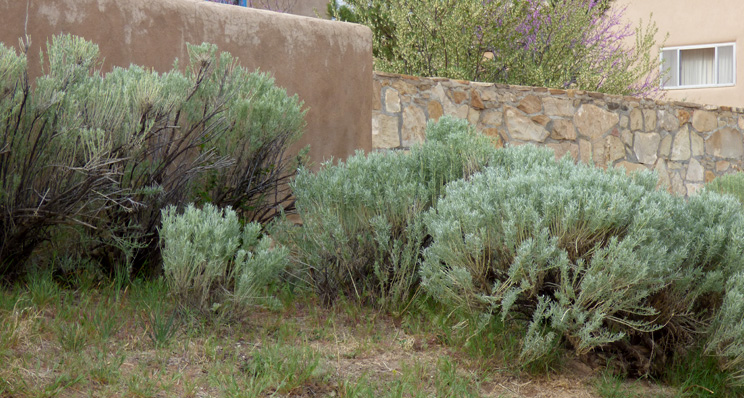
First on the list in April was pruning the chamisa (or rabbitbrush). Each of the dozens of tall shrubs needed attention, and I took it slowly, my aching arms reluctant to remember what physical labor felt like. But after some weeks my shoulders were toned and the rows of chamisa stood neatly.

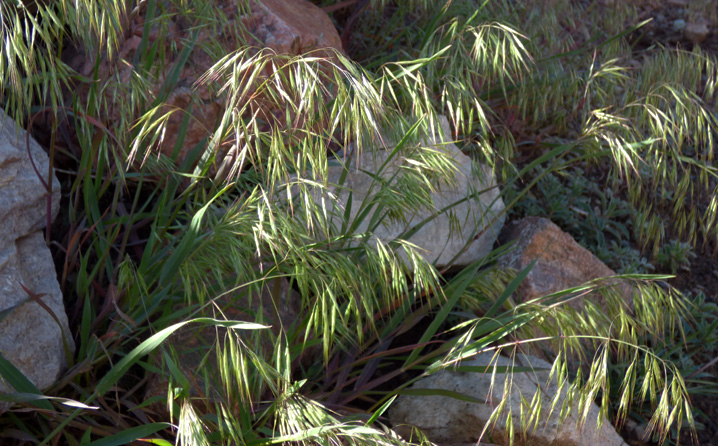
chamisa prunedAs the sun rose each morning, I would wander into the yard with a cup of tea and bend to the ground, hunting cheatgrass. I pulled cheatgrass by the stem, I pulled it by the handful. For two weeks straight I stuffed our 96-gallon trash can to the brim with cheatgrass stems alone. In shady corners it grew tall and lush, but on dry sunny slopes it could set seed from a stem only an inch or so high. My respect for cheatgrass grew, along with calluses on my knees.

cheatgrass among rocksBetween pruning and weeding, I tested the drip irrigation system ringing the property, digging up every line and replacing clogged parts. Did I mention an aching back? I’m ten years older than when I last crawled around a yard!

Through blustery days and warm scented afternoons, I pruned and weeded and dug. In April, bundled in long johns and layers, I was surprised to feel toasty and content even in strong winds and 48 degrees, as long as the sun shone. I let the peace of the dirt seep in. I followed the currents of birds and thrilled to the humming of bees hard at work in flowering trees. Gardening was good, I discovered, for the inner transformation I’ve been going through; living outdoors among the swirling nature helped me integrate.

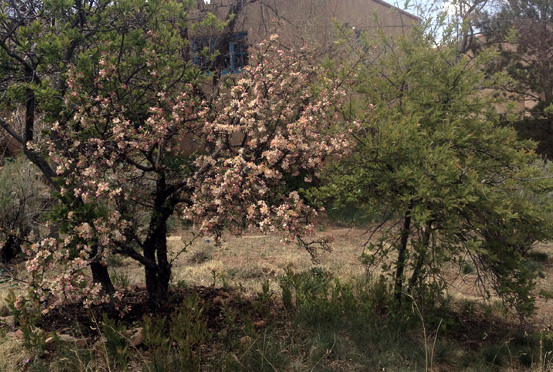
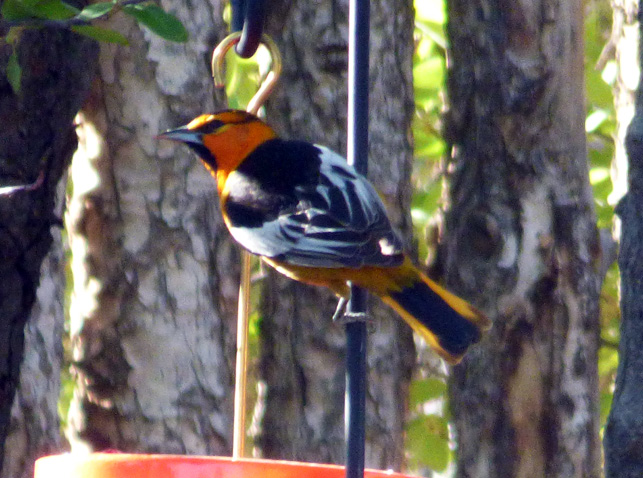
crabappleWhen I wasn’t gardening, I stalked birds in the yard with my new zoom lens. Bullock’s orioles are wary, and this male was so far away that he still came out fuzzy. New quest: a good oriole photo.

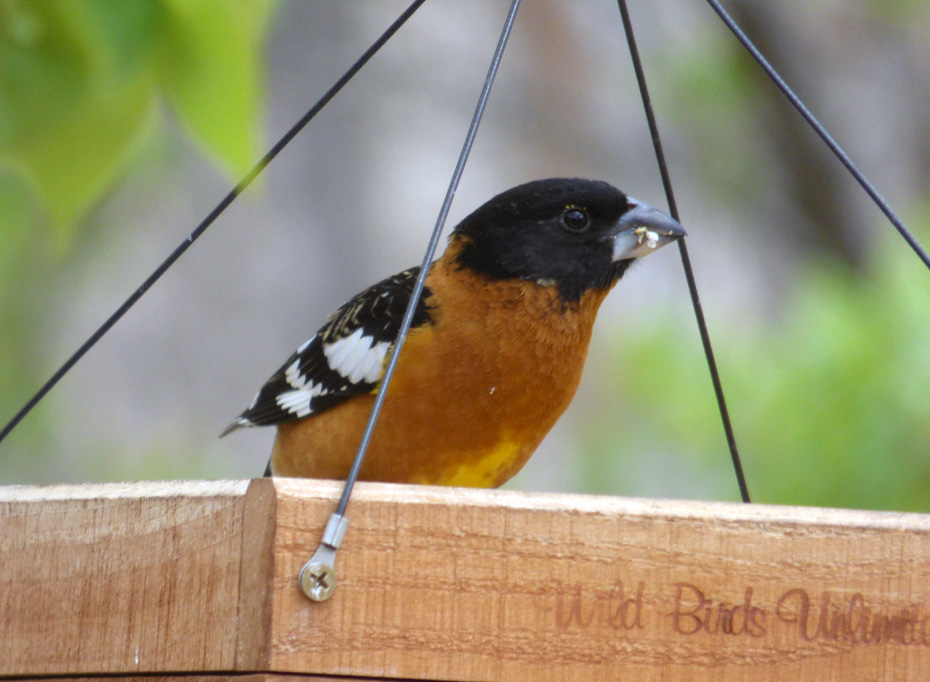
oriole at feederThis male black-headed grosbeak was more accommodating because I was hidden behind glass.

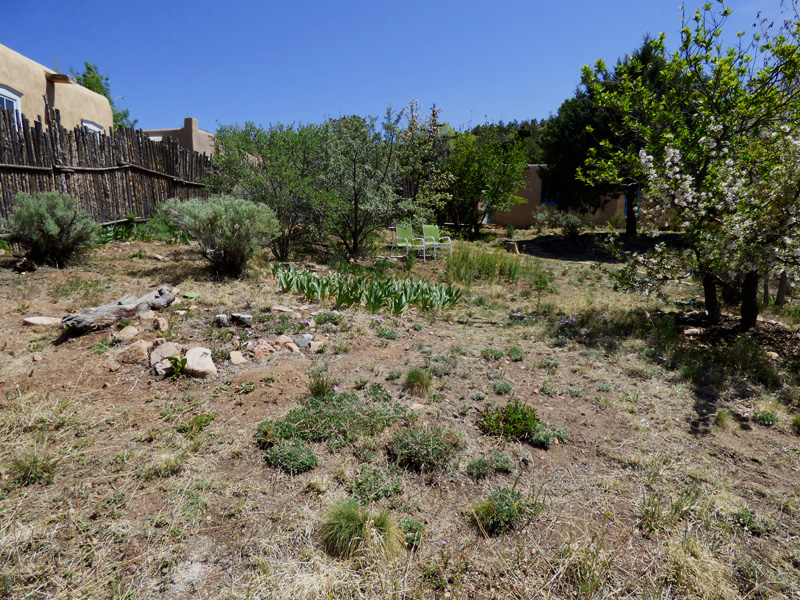
black-headed grosbeak at feederBy early May the yard was imperceptibly neater (imperceptible—after all those hours!) but still yellow-brown. After four years of drought, including a dry winter and spring, the land could not yet turn green.

yellow-brown yardI couldn’t wait to get busy sowing grasses and wildflowers. But at my favorite native plants store they told me that unless the ground had warmed up to 60 degrees the seeds would just sit there and not germinate.

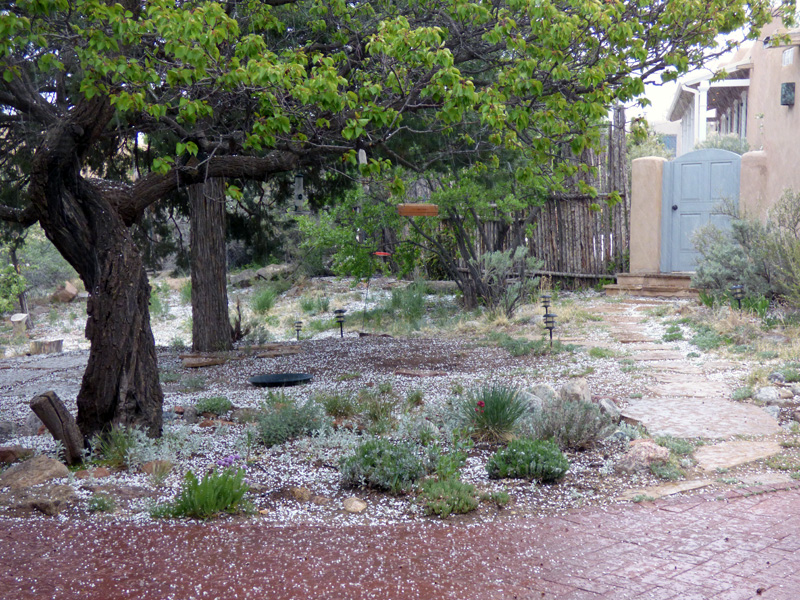
In mid-May we were enjoying balmy days in the high 70s, and I was chomping at the bit. But spring in Santa Fe is fickle, and at the end of one warm week we got a day of hail-sleet-snow and at the end of the next, on May 15, a killing frost.

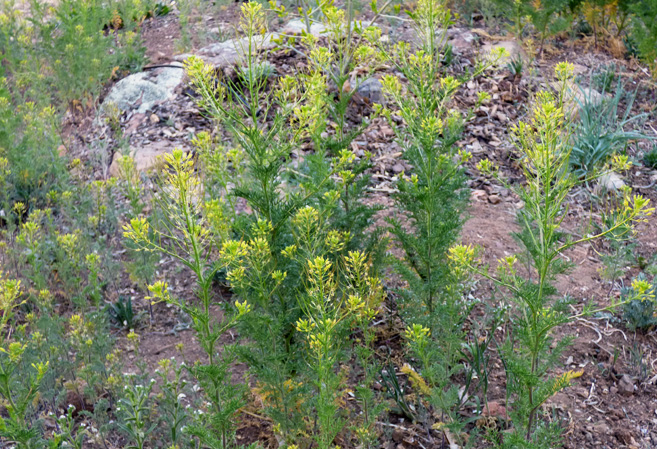
snow-sleet-hail in MayTime to wait some more. I took the opportunity to purge two weedy plants from the yard: mustard (it’s invasive) . . .

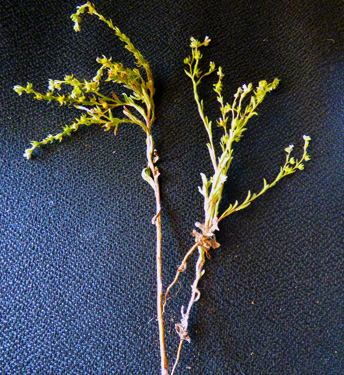
mustard in yardand stickseed (its prickly burrs hurt bare toes and demolish socks).

stickseedAt some point it dawned on me that I was doing restoration work. I’d helped to restore riparian corridors in Oakland and wildflower meadows in Boulder. Now I was managing my own high prairie restoration project in the Transition Zone of Santa Fe!

Jubilation was tempered by the the other realization that dawned about the same time: 12,000 square feet is a lot of space. This was a bigger job—and responsibility—than I’d expected. Anxious questions began to arise: How would I know when to plant? How much to plant? Was there any leeway for errors?

Finally the ground warmed up once more. I set hoses and sprinklers in place (no simple job to cover all from two faucets!). Was it time?

I followed the weather reports. Rain was predicted for the end of the week.

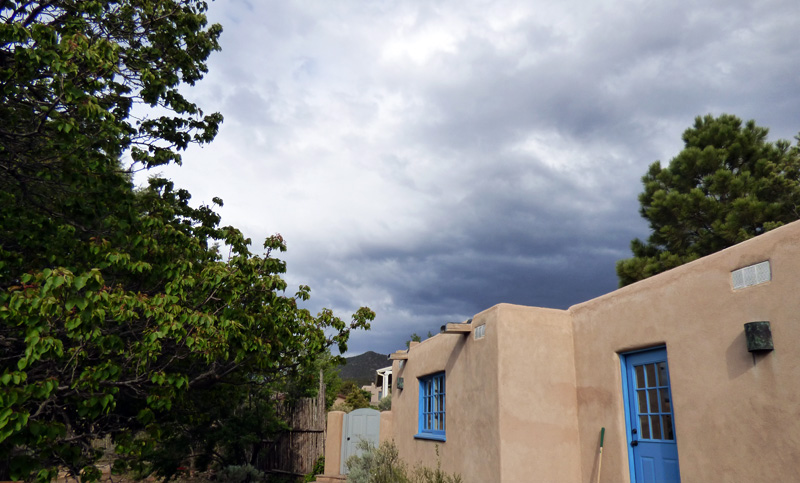
By Thursday afternoon all was in place. I checked the sky. The clouds were growing black. It was time to plant.

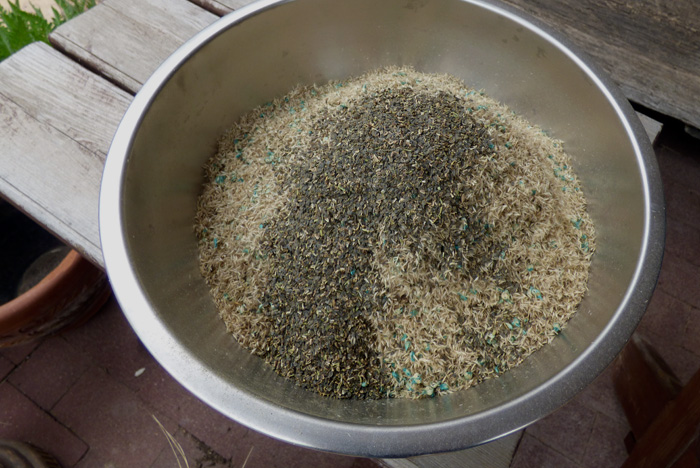
rain comingI opened bags of seeds and stirred them into a bowl: a mix of native blue grama and buffalograss plus wildflowers such as yellow coneflower, Mexican hat, blanketflower, and blue flax.

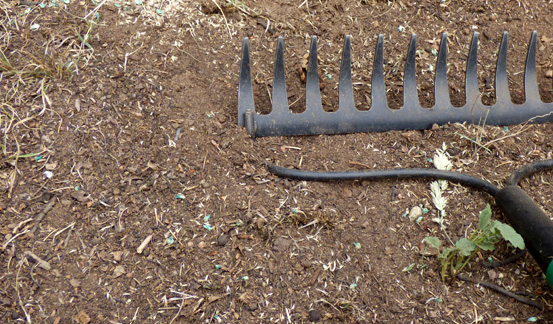
seeds from native plantsI sprinkled seeds onto the ground and lightly raked them in, not because these native seeds needed to be covered—they didn’t—but to hide them with the thinnest layer of dirt so that, as they told me at the nursery, “the birds don’t see dinner and the ants don’t carry them off.”

rake and seeds

Halfway through the planting the wind kicked up and threatened to carry off my precious cargo. I clutched the bowl to my chest, protecting its light-as-air contents, then enlisted Tim to follow right behind me with the rake.

The gusty winds foretold rain, but here in the desert I’ve already learned not to believe the wind. It may blow strong, and rain may fall from the clouds, parading across the sky, only to evaporate thousands of feet above the ground, never dampening the earth. So despite gusty winds, I set the sprinklers and gave the seeds their first bath.

At 3:00 the next morning I woke to lightning and thunder, then a sound I hadn’t yet heard in Santa Fe—rain pounding on a roof. I crept out of bed to a dark window.

Torrents of water! This drought-stricken land was finally getting relief.

The next morning dawned bright and sparkly fresh—for a few hours. What a gift, to see wet dirt where yesterday it had been bone dry! More heavy showers fell that afternoon, flooding city streets, then more rain on Saturday and Sunday as well—a dark and wet Memorial Day weekend.

The locals were delighted. Something in us relaxed as we felt the earth around us stretch and plump, freshening with new life. People greeted one another laughing. “Isn’t this rain wonderful?”

In between showers I wandered the yard, checking seeds. The rain had uncovered many but not washed them away. After two days of rain they began to stretch, their old jackets suddenly too small.

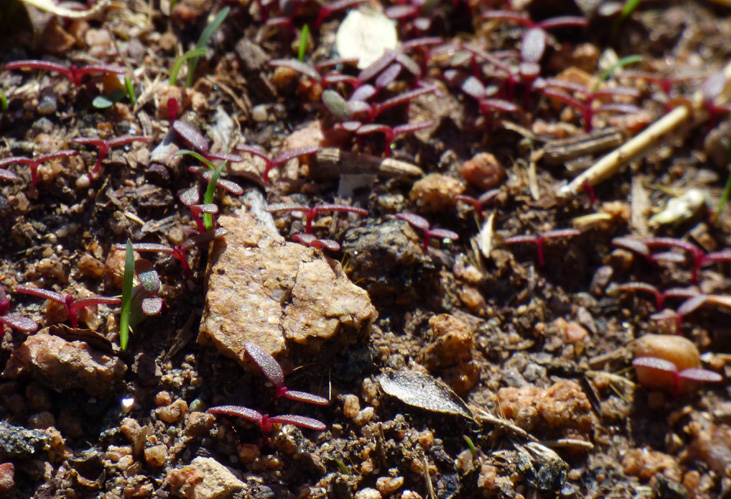
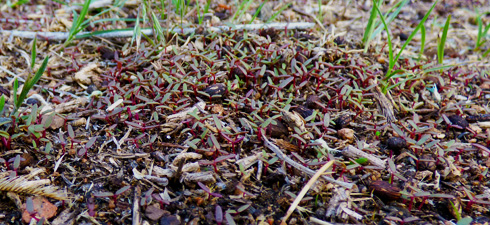
seeds after rainEach day for a week I checked the ground, waiting and watering. Finally I glimpsed the first evidence—thousands of minuscule shoots. I didn’t expect grass to be red!

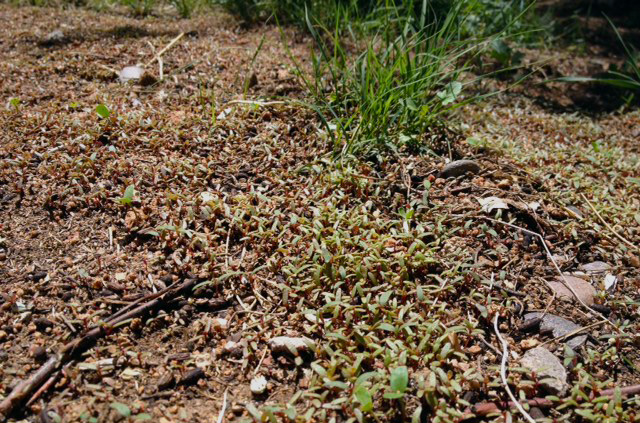
seeds sproutingseeds sprouting 2It’s been a week and a half since the seeds landed in dirt and were watered by glorious rains. Their tiny shoots are now weaving a gossamer green film across bare earth.

seeds todayMore updates to come!

Posted in nature | Tagged , , , , , , , | Comments Off on Farmer in the yard

The underworld is alive!

Sandra Steingraber spoke this week in Santa Fe, and as usual her words were disturbing and rousing at once. I’ve admired Sandra for years—her decades-long work as an Earth-advocate, first researching and writing about the public health dangers of everyday toxic chemicals and more recently working to end the insanity of fracking. This week she urged us to see these two huge issues as two trunks of a single “tree of crisis,” a tree with its roots in fossil fuels. “Our ruinous dependence on fossil fuels,” she said, underlies both of these Earth-killing crises.

Steingraber is a biologist, and she spent an early part of her talk outlining the mechanics of climate change because, as she explained, in one survey 350 well-educated people were asked to describe the process, and “exactly no one got it right.”

But where Sandra’s talk really came alive for me was when she described the ecosystem of shale, the deep rock a mile underground where fracking is done. The shale is full of methane bubbles, which are actually, she explained, the fossilized bodies of the billions of sea creatures—the only form of life at the time—who died hundreds of millions of years ago.

These little, effervescent methane bubbles—what we are in such a hurry to extract—are the decomposed bodies of sea lilies and squid. They didn’t decompose as ours do because the chemistry of the Earth was different at the time. They decomposed as bubbles of methane buried in shale.

And methane, of course, is natural gas.

So the beds of shale where fracking is done are actually vast burial grounds, cemeteries, holding the bodies of billions of sea creatures. When you turn the the gas on at your stove, you’re actually using the decomposed bodies of these creatures.

And then she got really excited as she introduced us to organisms that many of us had never heard of: the archaea, a third domain of life (in addition to bacteria and eukaryota—plants, fungi, and animals). My generation never learned about archaea in school because they hadn’t been discovered yet, and they weren’t classified as a separate branch of life until the late 1970s, when I was in college.

First found in extreme environments, like Yellowstone’s hot springs, archaea are now recognized as living everywhere, including in people’s belly buttons. They are one-celled creatures, like bacteria, but their chemistry is different, and many still love the weird chemistry of Earth’s environments 400 million years ago, when archaea evolved, when the oceans were hotter and there was less oxygen, which is why many of them thrive in what we think of as inhospitable conditions.

And that’s where they connect up with the ruinous practice of fracking. Some archaea live deep underground, a mile below the surface of the Earth, where fracking is done. Steingraber said,

The underworld is alive, and I don’t mean in a mystical, Gaia-is-alive kind of way. I mean literally alive. Metabolically alive. With these one-celled creatures.

Archaea are so alive, in fact, that they have figured out ways to move electrons around and alter their environments. The archaea living a mile below the surface lack means to transfer electrons themselves, so they use rock. Steingraber the biologist got all animated at this one:

They send electrons into rock to alter their environments. They send nanowires into rock! They make grids of nanowires. They make complex colonies!

The ooohs and aaahs of the audience underscored our shared amazement. We’d never heard of these creatures. And yet somehow we immediately sensed the larger truth: we’ve been carrying around the wrong metaphor of the underworld. Not a shadowy place of the dead, the deep strata of Earth are very much alive—with colonies of one-celled creatures.

Those living communities of very active creatures deep underground like to wreak havoc with drilling and extraction. (Good on them!) Archaea are so alive and prolific that they tend to clog the pipes and stop the flow of methane. (Smart archaea!) This is why uber-toxic chemicals are added to the fracking fluids—to kill off the communities of microbes and keep the methane flowing. These superconcentrated pesticides are the toxins that can percolate into groundwater when cement casings crack and fail. As Steingraber reminded us,

Because we now know that 5 percent of drill casings fail from the start, and the failure rate continues to increase as the cement casings age, shrink, and crack.

Out of Sandra’s disturbing, discomfiting talk, I took this one piece of joy: the living cacophony of Earth extends far below the surface and is far stranger and more wonderful than we have imagined. Steingraber said,

What we need to take away is that the surface ecosystem extends a lot further underground than we thought. We were wrong about the underworld. It’s very much alive.

________

For more information:

Sandra Steingraber’s website gives information about her books, including her recent Raising Elijah, calling for heroic actions to match the severity of our current ecological crisis.

“Coffee in Jail” from Orion is one of my favorite essays, about landing in the county jail for civil disobedience against fracking and how she discovered a piece of writing in her cell that she didn’t expect.

Posted in nature | Tagged , , , , , , , , , | 1 Comment

What’s the end of this story?

I am not a collapsitarian. Yes, I firmly believe that industrial civilization has pointed its collective GPS straight toward the cliff. But I don’t write about collapse, and I don’t often talk about it. Why not? Because focusing on collapse tends to convince people there is only one ending to the story. It’s an arrogant and hope-sucking conviction—and it is simply false. We do not yet know the end of this story.

So when the Guardian announced this month that industrial civilization could collapse in coming decades, I sucked in my breath. And when it said that its story was based on a study about to appear in the peer-reviewed journal Ecological Economics, a study that was funded in part by the Goddard Space Flight Center of NASA, I knew that fringe headlines had just gone mainstream.

The authors of the study compared human-nature interactions in certain advanced, complex civilizations in the past, such as Roman and Mayan, with those in modern industrial society. They conclude that under conditions similar to today’s,

we find that collapse is difficult to avoid.

The week this study was publicized was the same week, as it happens, that the American Association for the Advancement of Science (AAAS), the largest scientific society in the world and a notoriously staid group, issued a bold call to action. “What We Know” is a clear, calm document with some blunt facts about climate change. Point 2:

We are at risk of pushing our climate system toward abrupt, unpredictable, and potentially irreversible changes with highly damaging impacts.

Two warnings of collapse in the same week: serious changes lie ahead.

I find the warnings oddly cheering. I feel less crazy than I did a few years back, when the evidence for collapse was just as strong but we had our collective head buried in the sand about climate change. What people are feeling and what they are saying no longer belong to separate universes. We are being more truthful, or at least beginning to be.

I do have some serious questions about the NASA-funded study. Comparing modern society to Roman or Mayan is fraught with problems, one of which is that we don’t actually know what “collapse” in those societies looked like. The “fall of Rome,” for example, may have had little impact on the shape of everyday life for most people. (You can read more about this in chapter 12 of Kissed by a Fox, which I based in part on the work of historian Peter Heather.) Did “collapse” mean that people spread out away from what had been cities, as some Mayan scholars think? If so, it suggests there was someplace to go—very unlike the situation we face today.

But about the AAAS document I have no questions. Its three points bear repeating:

  1. Climate change is real, it’s caused by us, and 97% of scientists agree.
  2. We may be changing nature irreversibly.
  3. There is much we can do.

I want to focus on number 3: There is much we can do. On this point both studies completely agree. Societal collapse, while difficult to avoid, is not inevitable.

We could reset the GPS by choosing differently.

Right now.

The NASA-funded study offers two excellent recommendations:

Collapse can be avoided and population can reach equilibrium if the per capita rate of depletion of nature is reduced to a sustainable level, and if resources are distributed in a reasonably equitable fashion.

In other words, use fewer resources per person, and distribute resources more equally.

The AAAS document is even more blunt:

The sooner we make a concerted effort to curtail the burning of fossil fuels as our primary energy source and releasing the CO2 to the air, the lower our risk and cost will be.

These are straightforward assignments. The job ahead seems clear:

  1. Cut down on consumption. Stop burning fossil fuels.
  2. Work toward greater social and economic equality.

Each one of these is a monumental task. But people change, and even societies can change on a dime. When I was a child all restaurants and offices were blue with smoke. Smoking was entrenched by centuries-long habits and big money. Few could predict that in forty years most environments would be smoke free.

At this moment, we need the biggest change that has ever happened, because the stakes are higher than human beings have ever faced.

Will we challenge laws that stimulate endless growth? Will we wake up to our interrelatedness with all other creatures? Will we insist on solar power? Will we begin to reward reciprocity instead of profit? Will we design interactions based on respecting nature more than using nature? Will we pass rights-of-nature laws to guarantee healthy eco-communities for the children now being born?

I don’t know. But I do know that every one of these is possible.

And even if we did all this, would we avert the cliff? This too I don’t know. And neither does anyone else, because the end of this story is not yet written.

How do we live in a time of eco-crisis? I take heart from the wisdom of Buddhist teacher and writer Joanna Macy. A few months ago she said:

Yes, it looks bleak. But you are still alive now. You are alive with all the others, in this present moment. And because the truth is speaking in the work, it unlocks the heart.

We need our collective heart. Which means the heart of each person. You. Me. Everybody. Whatever we do that brings us back to the heart will help. Every little thing we do to increase respect and equality and happiness—to bring that little spark of warmth and aliveness back into people’s eyes—will help. Because the more of that warm spark, the less stuff people need and the more love they show each other.

And whether or not we avert the cliff, we will have a much better time getting from here to there, and if we can increase the work of the heart, the “there” we arrive at will be much kinder and more livable for everyone.

Even—and perhaps especially—in a time of eco-crisis, we can answer the summons. Macy continued:

It’s like a trumpet call to a great adventure. In all great adventures there comes a time when the little band of heroes feels totally outnumbered and bleak, like Frodo in Lord of the Rings or Pilgrim in Pilgrim’s Progress. You learn to say “It looks bleak. Big deal, it looks bleak.”

And you do it anyway—for the adventure is not yet finished, and astounding challenges can call forth astounding creativity.

This is a time for big risks and big changes. This is a time to pull out all the stops. This is a time to stand up and be counted in our collective story. Because each of us is a character, each an actor in this story.

What’s the end of this story?

Come on, let’s find out.

Update: For excellent critiques of the NASA-funded study, see this article by Ian Angus at Climate & Capitalism, posted March 31. The author of the Guardian report defends here his claim that the study was partially funded by NASA.

Posted in nature, politics, spirituality | Tagged , , , , , , , , | 12 Comments

Savory butterfly snack

I’m not much of a winter hiker, so during snowy months I get a nature fix from a different source: working on my growing collection of banner images. With January’s additions, the collection numbers more than 180, and you can view the whole gallery here.

At some point I want to write a blog post about the fun yet often tricky process of cropping photos into the strange shape of 596 by 175 pixels, but today I’m focusing on one image only:

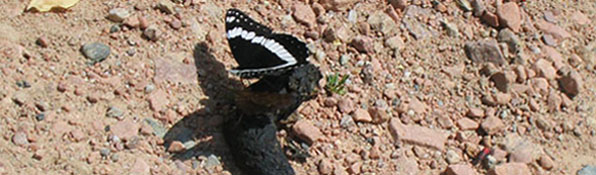
butterflyondogpooGoshawkRidge061010This is a Weidemeyer’s admiral butterfly (Limenitis weidemeyerii), photographed on the Goshawk Ridge Trail in June 2010. This butterfly was perched only a short ways up the fire road, which was great because that day I was recovering from a bad sprain and couldn’t hobble far.

He caught my eye because he was sitting where I didn’t expect: on a drying piece of dog doo in the middle of the trail. Every time I see this photo it makes me chuckle because without looking closely at the photo, one would never notice what the butterfly is perched on.

Actually, there is a second joke in the photo: the Weidemeyer’s admiral has company on the dog doo, a smaller, orange-brown butterfly, probably a fritillary, hidden in the shadow of the larger butterfly’s wingspan. Together, the butterflies make a combined shadow on the ground that echoes the coloring on the Weidemeyer’s admiral wings—but again, without stopping to notice, one might not register that the shadow on the stones is made by two butterflies, one whose wings are open, the other’s closed.

Spotting this pair was the first time I noticed that butterflies like to hang out on dog doo. So of course it raised tons of questions: Why dog doo? What are the butterflies getting from it?

I put my questions to the experts, Jan Chu and Steve Jones, coauthors of the marvelous guidebook, Butterflies of the Colorado Front Range. They agreed: these butterflies are male. They are soaking up nutrients from the dog doo.

What kind of nutrients? Jan explained: during mating season male butterflies snack on dung to pick up minerals and proteins, which then go into forming the spermatophore, a capsule that encases each sperm. While mating, the male passes these packages of sperm and nutrients along to the female.

The day I photographed these butterflies was also the first time I’d seen a Weidemeyer’s admiral, one of the special butterfly residents of the Rocky Mountain region stretching from southern Alberta down to southern New Mexico and Arizona. They live in stream areas, where females lay their eggs on the undersides of willow leaves, sometimes also cottonwood or aspen. One fun fact about these butterflies: caterpillars may overwinter during their third stage of transformation, curling up in a tiny white sac that hangs from the bottom of a leaf and looks like a bird dropping, thus discouraging predators. The caterpillar simply hibernates during its third stage, taking a several-month-long wintry pause in its development.

Many butterflies, it turns out, prefer dung or carrion to flower nectar; for some beautiful close-up photos of butterflies on dung, see this blogger from Vancouver. For ideas on attracting dung-loving butterflies to your yard—without the dung—see this page. You can try setting out a banana peel or a bunch of compost made with cow manure. Apparently many types of rot keep these butterflies happy.

Finally, a special shout-out to my web developer, my own sweetheart, Timothy Falb, who not only put together the page of banner images but also devised a clever automated system that prevents my site from bogging down with images. Instead of loading all 180 images at once, the system randomly picks 15 at a time and changes those 15 each time the page is refreshed. (Tim programmed this whole site, for which I am grateful!)

Tim’s innovation means that I can add banner images ad infinitum. Or until winter ends. Whichever comes first.

Posted in nature | Tagged , , | 6 Comments