It’s all about relationship

About a year ago I found myself drawn to a new phase of nature relationship. It became clear that I was being called to a spiritual path that is often called shamanic, though for reasons I’ll get to, I find this word troublesome. But anyway. This spiritual path, I learned, had a claim on me that ran even deeper than that of writing.
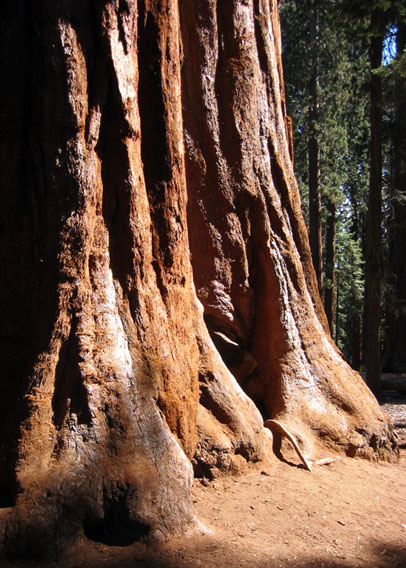
In shamanism, giant sequoias hold wisdom to be listened to.That I was so deep on a spiritual path was news to me. In retrospect, the fact that I was so surprised makes me laugh. I mean, really—someone who wrote a book about talking with trees and animals and land, and didn’t call her path a spiritual or shamanic one? When I “came out” to friends about this new spiritual direction, they listened unsurprised and then often chuckled at me. “You mean you didn’t know?” they asked.

No, I didn’t. The universe is a trickster, it is said, and in keeping with the cosmic joke I was the last to know.

And once I did hear the news, I was none too pleased. This too makes me chuckle—now. At the time I was in no mood to appreciate either the joke or a new identity. Writing the book had taken me through a marvelous integrating process—pulling together pieces of my story and a shared cultural story—and I was looking forward to wearing the writer identity for the rest of my life. I was not at all thrilled to hear that writing, for me, might not be a role to reside in but rather a useful skill—something I do not for its own sake but for the sake of something else. Tim will tell you I went kicking and screaming on this one.

And then there was that word: shaman. It comes from the Tungus-speaking people of Siberia and means a person who is called by the community to talk with more-than-human beings on behalf of the community. Many indigenous people believe that the word shaman—and the traditional knowledge it represents—should stay with indigenous people. In recent decades, as white people seek nature-based forms of spirituality, many Indians have denounced the spiritual appropriation that so often takes place—white people stealing indigenous traditions or at least acting like they own them. It’s colonialism in yet another terrible form. Shamanism is a frequent focus of concern; for examples, see here and here. Since I moved to Santa Fe, an Indian friend warned me that I might not want to use the word shaman if I want to get along peaceably with the Native people among whom I now live. “This isn’t Boulder,” my friend said. “Things are different here.”

But my Indigenous friends are not the only ones disliking the word. From the start of this path I found that what I was learning seemed quite different from the way shamanism is usually taught among white people. Often students are introduced to the path through its techniques—journeying, finding animal-spirit Helpers, drumming or rattling or dancing to induce trance, and so forth. By contrast, on the path I was learning, no drums or rattles, feathers or sage were called for. In fact, the only tools I use so far are a recorder—the built-in recorder on my smartphone—and earbuds. That’s because the focus of the path is conversation. In other words, relationship.
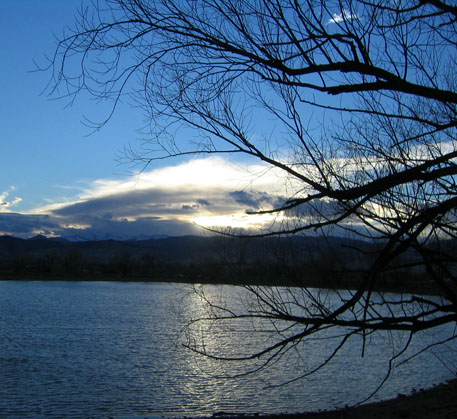
Shamanism is a path of listening, and finding quiet places like this small lake to listen to the still small voice.It works like this. I go sit by myself, turn on the recorder, and begin listening. I listen for the still small voice of a more-than-human Helper. One Helper in particular, a wise and kind animal, is my primary Helper. Why the sacred shows up in this particular form I cannot say, except this much I have learned: my animal Helper often has a jolly sense of humor and seems to be imparting some of it to me. If a Helper’s job is to provide the grace a particular person needs, then apparently I have a lot to learn about enjoying life and learning to chuckle at human foibles. Especially my own.

And here’s the thing: the relationship with my Helper is making a difference. Tim will tell you I have gotten happier over the past year, and an intimate partner knows the truth. He says I am less prone to impatience and irritation, more ready to laugh. My personality is changing. Or rather, is being changed.

Because that is what happens in a relationship. In drawing close to another, we open to something new. And that is the piece so often missing from the teaching of shamanism among white folks—how it’s not about visiting other worlds or seeing visions or doing wondrous things, though all of these things can and do happen. It’s about cultivating an awareness of the divine. Listening for the still small voice. Learning to dwell in the daily presence of Spirit.

And being changed in the process.

It’s a path of devotion, of direct communication, with echoes of Rumi yearning for his Shams, of St. John of the Cross stealing away to rendezvous with the Beloved, of the psalmist following a Shepherd. Here, by the way, is a musical setting of the Twenty-third Psalm (by Bobby McFerrin) that I have loved for decades:

Once the conversations with the Helper are recorded, the work has only begun. Then the job is to listen to the conversations and transcribe them. And in the days to come I do it all again. Later I come back to the transcriptions and reread them, always open to seeing something new—and finding it. They usually speak in a new way to the situation I am facing during that time too.
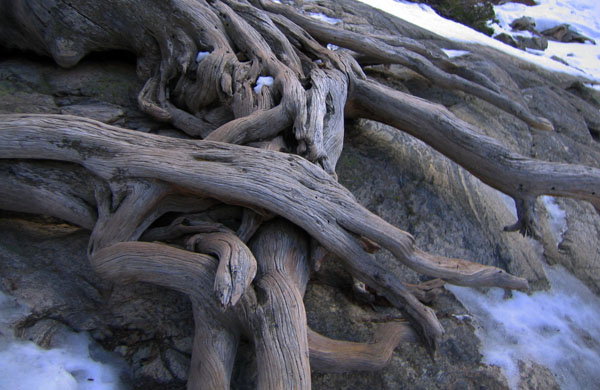
Shamanism teaches respect for the complexity of life.I’ve been through rigorous academic programs, and this one matches them. Except in this one my textbook is not the voices of other human beings but the voice of a more-than-human ally. The curriculum is relationship.

I do have a human mentor in this process, a woman who was taught not by other human beings but by listening directly to the Helpers. She makes it clear that she is not my teacher. “You and I are in a classroom,” she says. “You are sitting at one desk, and I am sitting at another. But the Helper is at the head of the class.” The source is within each of us, just as it is within all parts of nature. It is each person’s privilege to cultivate their own direct awareness of it.

What do I call this path I’m on? For now I just say, I am one who listens. A daily walk with Spirit—that is my practice.

_________

I am learning how to pass on the supportive wisdom of the Helper to others. For more information, see my Come Home to Nature, Come Home to Source page.


Posted in nature, spirituality | Tagged , , | 2 Comments

What did water say?

Our move to New Mexico in December may have taken place with lightning speed, but as I look back over the fall I see months of internal preparation that I hardly realized at the time were happening. And a lot of that preparing was shaped by the Boulder flood.

Way back in September, while the rains that made the flood were still falling, my longtime friend Malidoma Somé came to Boulder on a speaking tour. It was the first time we’d seen each other in the more than fifteen years since we’d worked together in Oakland on his book The Healing Wisdom of Africa. That night in flooded Boulder he encouraged each person in the room to listen for what the water was saying to them. “There is tremendous life-force in the flood,” he said. “What is that water wanting to share with you to help you release your gifts into the world?”

I’d been thinking along similar lines, discontent with the judgment so many people fall into during so-called disasters. If an unexpected event is a challenging one, it must be some form of punishment. “There is some confusion in people’s minds between a spiritual perspective and a judging perspective,” a wise friend told me during that time. Malidoma and my friend were suggesting something similar: find the interpretation of an event that supports you in opening to the future. Find the story that empowers.

So in the weeks following the flood, as my community picked itself up and helped one another clean up, I listened closely for what water was saying. And here are a few of the empowering things I heard.

1. Keep the water-paths open.

The empowering story for me began to center on the free flow of water: how waters must be free to do their cleansing work across the land.

In Boulder I lived near a creek that everyone had forgotten, Twomile Canyon Creek. Culverted for a century and then dammed in 2005 a mile above town, Twomile Canyon Creek as it ran through my neighborhood was only a dry bed—until days of rain caused it to swell and spill. It shrugged at culverts and streamed in its old path downhill, flooding houses west of Broadway near Iris, Juniper, and Kalmia. The water poured for days across Spring Valley and Linden Drives.

Twomile Canyon Creek watching

Creekflow and silt still cover Linden Drive days after the flood.

I was fascinated by Twomile Canyon Creek’s fresh vigor. So was everyone else in the area. With Bodhi, I would walk to Linden and encounter others also making their pilgrimage to stand and watch and listen to the surging flow, all of us trying to wrap our heads around such tremendous power.

Keeping water-paths open can apply to sewer lines and creekbeds; it can also apply to the chambers of the human heart. Let the inner streams be open and free, the water seemed to suggest. Don’t get in the way of inspiration. Be available for the fresh influx of powerful flows you may have forgotten—or never recognized.

Images of water flowing over roads stayed with me for weeks, even after the creek had subsided again to a friendly gurgle.

Twomile Cyn Creek gurgle

Same spot on Linden Drive on Sept 23, twelve days after the flood.

The memory of the flowing water began to beat a mantra all its own:

2. Let old structures fall.

Old, inhibiting structures will crack under the onslaught of a flood. Let them, the water said. Whatever impedes the flow of life-force needs to be called into question. Old structures can mean dams and roads and houses standing in the way of a creek. It can also mean the structures of life that we rely on to usher us from one day into the next: a well-worn identity in work or love, our super qualifications for jobs that may no longer be compelling. When the old structures crack, the water said, don’t try to shore them up. Let them fall.

3. Things can change overnight.

We all know that things change suddenly. We also fear it. And because of our fear we don’t allow ourselves to dwell in the awareness of change. Only when life suddenly shifts do we realize just how much we were counting on it to stay the same.

new canyon in Chautauqua

New canyon in Chautauqua below the first Flatiron.

The power of water to reshape the land we thought we knew was nowhere so obvious as in Chautauqua Park, where water flowing off the Flatirons punched brand-new canyons into the earth. In moments, forty-foot-deep canyons suddenly opened, their many tons of displaced boulders racing downstream with what neighbors said was the roar of a freight train. It was a miracle that no one in the streets below the park was killed or seriously injured.

The park as we knew it was transformed. We were used to the trails looking one way, and we loved them that way. We had forgotten that the ground beneath our feet, which may look stable, is in fact a churning mass of change. Every creekbed has been scoured by water. Every canyon winding out of hills was first eroded out of flat earth, then widened and deepened over and over again, perhaps several times a century, by raging floodwaters. We think of changes in rock and soil taking place on the scale of geologic time. We forget that the drama can unfold in a single night.

Boulder’s Open Space and Mountain Parks offered flood hikes for the public every weekend during the fall to see lands changed by the waters. I went many times to visit those brand-new canyons. To try to comprehend the immensity of water’s power. To see if absorbing changes in the land could help make peace with changes in life. Each time I visited those new canyons, I was astonished all over again.

I regret that I won’t be in Boulder to continue being astonished—to watch the land adjust, week by week, to its new shape. Spring and summer will bring many opportunities for wonder. Yet I sense that even the few weeks I enjoyed during the fall worked some magic. Living through the abrupt changes of the flood prepared me for rapid changes in life. Feeling devastation and awe set the stage for sudden and sweeping changes in other parts of life.

When the opportunity arose for us to move to Santa Fe, we found that something in us had been cleaned away. With barely a pause, we said yes.

I can’t resist closing with a couplet from Rumi that I used in the book:

The speech of water, the speech of earth, and the speech of mud
Are heard by those who listen with the heart.
—Rumi, The Mathnawi

May the stories you listen to always be stories that empower.

Posted in nature, spirituality | Tagged , , | 8 Comments

Happy New Year from New Mexico!

Happy New Year—from a place I never expected to call home! A quick switcheroo brought us to Santa Fe, where we have been enjoying the special magic of the holidays. Christmas Eve found us on the Canyon walk along with 30,000 of our neighbors, enjoying the warm glow of thousands of farolitos—or are they luminarias?—lining every building on the street.

Luminarias on Canyon Road in Santa Fe More luminarias on Canyon Road in Santa Fe

People gathered by the dozens around the little bonfires in the street, called luminarias—or are they farolitos?—to warm up from the chilly night and to sing carols.Singing around a bonfire on Canyon Road in Santa FeMy favorite gathering was the brass ensemble, about half a dozen horns plus a sax or two, leading “It Came upon a Midnight Clear” in expert style while people around the fire sang not just one or two but all four verses, reading from their sheet lyrics. Then the band broke the solemn tone with “Chicken Dance,” complete with motions, explaining that this was indeed “a Christmas chicken!” while we all chicken-danced in the street.

Everybody now—”I don’t want to be a chicken . . . “

Handcrafted door in Santa FeOur move to Santa Fe came about unexpectedly, but in hindsight it makes perfect sense. An opportunity opened up to rent a house in this city I have loved for twenty years, and being self-employed, we were free to turn on a dime. The move took place, start to finish, in about six weeks, the idea arising just days after my last blog post. We’ve been here half a month. My head  is still spinning.

I love being in walking distance of the Santa Fe plaza. I love the beauty that catches the eye at every turn.

 Carved facade downtown in Santa FeI love the history of handcrafting everywhere displayed.

Carved wooden door in Santa FeAdobe architecture has long made me drool—and now I get to live in it! (This is not our front door, but it’s nearby.)

Sending warm good wishes to each of you, and may you dwell with your loved ones in peace and beauty this year.

Posted in Uncategorized | Tagged , | 10 Comments

A healthy environment is a human right

Today is Blog Action Day, and this year’s focus is human rights.

Because we are so used to perceiving humans and nature as separate, it may not at first occur to us, when thinking about human rights, to look immediately at the environment. Yet what right could be more fundamental than the right to a healthy, flourishing environment?

Human rights include the right to a healthy, flourishing environment.

The U.S. Constitution is famous for recognizing the human rights to “life, liberty, and the pursuit of happiness.” Yet a healthy environment is fundamental to each.

Life. Human life is made possible by the surrounding environment. When waters and land are polluted, people and other creatures are born with greater health problems, and human living is circumscribed by the limits of an ailing ecosystem. Our very life as human beings comes from nature—from the millions of organisms and species who preceded us in evolution and lent us the benefits of their billions of years of experiments with life. Without a healthy environment, we cannot be healthy. Without the flourishing of the myriad other species with whom we share this planet, we cannot flourish.

Liberty. We usually think of liberty as freedom from being oppressed by other human beings—freedom to act as we see fit within laws that promote the well-being of all. A healthy environment is fundamental to freedom, for lacking the flourishing of other beings and forces in nature, we will not have the foundation to carry on human activities. Liberty is mocked when people do not have access to healthy food; liberty requires the freedom to find and eat healthy food. Liberty is irrelevant when people lack fresh water; liberty means access to fresh safe water. Freedom, at its heart, requires a healthy, functioning ecosystem.oak tree

Pursuit of happiness. It has been established many times by research in community psychology (here’s one study) that people who live in polluted or degraded environments are prone to greater depression, anxiety, and aggressiveness. Happiness is not possible without a healthy, flourishing ecosystem. Our very ability to pursue happiness depends on the flourishing of the many other beings and species in the land community in which we live.

The environmental philosopher Thomas Berry said, “Every component of the Earth community has three rights: the right to be, the right to habitat, and the right to fulfill its role in the ever-renewing processes of the Earth community.”

Today the Boulder County Planning Commission will consider including one sentence in the Boulder County Comprehensive Plan:

We acknowledge the rights of naturally occurring ecosystems and their native species populations to exist and flourish in Boulder County.

This sentence was proposed by members of Boulder Rights of Nature (of which I am a board member) and Boulder County Audubon.

Recognizing human rights leads to recognizing the rights of nature. The two are inseparable. And for good reason—because humans are inseparable from the rest of nature. We are one community. The ability of humans to flourish depends on the flourishing of the land community within which we live.

A healthy environment is a human right. It is also the foundation of all human rights.

Courtesy of: http://www.blogactionday.org
Posted in nature, politics | Tagged , , , , , , , | 4 Comments

NOAA and the flood

Water will win. As we dig out in Boulder from this great flood, we have a new appreciation for the overwhelming power of water. Roads destroyed, lives lost, houses and buildings shoved roughly downhill. Even on my street, on high ground away from creeks, almost every basement filled with several inches—or feet—of water. Throughout the region, water pounded new-old paths downhill; water saturated the ground; water raced to flow into any space it could find.

This week a panel of climatologists and meteorologists gathered at CU to talk about September’s severe flooding. (Listen to the presentation here. The Daily Camera did a story here.) Sponsored by CIRES (Cooperative Institute for Research in Environmental Sciences) with help from NOAA (National Oceanic and Atmospheric Administration) and CSU’s Colorado Climate Center, the panel addressed two big questions:

  1. How rare was this Boulder flood?
  2. How much did climate change play a role?

The second question was easier than the first. Yes, said the scientists, climate change does increase water vapor in the atmosphere, but the amount is still very, very small. So:

Climate change did not play a discernible role in the current flood.

More disturbing, said one panelist, is that our historical records are so short. We sit on 150 years of data and “feel smug,” thinking we’ve got the bases covered, when in fact “nature can deliver.” How do we know what average rainfall or flooding intervals were prior to the Industrial Revolution, when we started burning fossil fuels? We don’t.

The panelists’ answer to the first question was more sobering:

This flood was not rare.

It’s been called a 100-year or even a 1,000-year flood, but the downside of using those terms is that we delude ourselves into thinking that a flood like this doesn’t happen very often. In fact, similar flooding has happened in Boulder, not once, not twice, but a handful of times in the last hundred years alone.

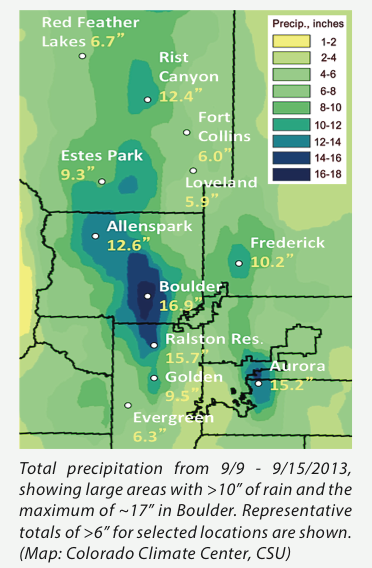
Map of rainfall during Boulder floodWhat was rare about this event was the rainfall—fairly slow as deluges go, except for a few brief spikes, but so steady and sustained over so many hours and then days that it amounted to totals previously unheard of. We set records for 1-day, 2-day, and 7-day totals of rain—more than 9″ in 1 day, nearly doubling the old record of 4.8″, and almost 17″ in 7 days, or nearly a year’s worth of rain for this area in one short week. The map of rainfall totals in the area is taken from the report put out by the panelists.

The heavy rains (rather than overflowing creeks) are what caused Boulder basements far from creeks to flood, as the ground simply could not hold that much water. We haven’t yet heard from geologists about this event, but when we do I suspect they will talk about a rock-sold layer of clay that underlies the region a couple feet below the surface—the layer of rock that I’ve heard my gardener and builder friends complain about. Hitting that clay table, the water had no place to go and so flowed into basements.

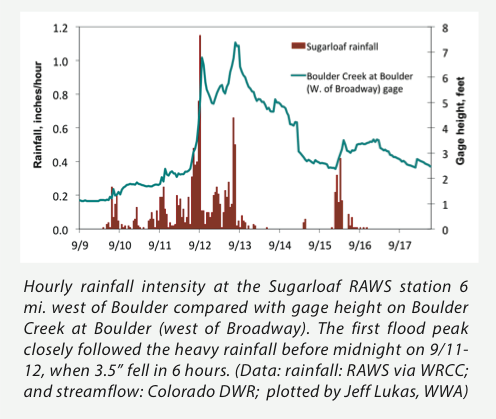
But as for creek flows, they were not extraordinary. During this event, Boulder Creek peaked twice in flood stage. The second time, just after 9:00 pm on Thursday the 12th, creekflows reached 5000 cubic feet per second, or 100 times more water roaring down the creek each second than had been flowing just before the storm.

Rainfall intensity and Boulder Creek flow

One astonishing thing to see in this graph is how fast the creek approached flood stage. Before about 9:00 pm on Sept. 11, the creek level was slowly rising. But within an hour or two at most, its flow shot upward—from “water rising” to “life threatening” in a matter of minutes.

And yet the peak flow on Boulder Creek was not that rare. One of the most sobering sentences from the meteorologists’ report is this simple summary:

The peak flows at many gages and the overall extent of flooding were probably unmatched in at least 35 years.

Only 35 years. Not 100. This means that flooding of this magnitude can be expected several times a century. It happened a few times in the past 100 and will likely do so again.

Which calls into question what Boulder mayor Matt Appelbaum said: “You can’t design your entire sewer storm system for 100-year or greater events. I don’t think it’s feasible or something you’d have the funding to do.” He may be right about the funding, but Boulder residents are no doubt going to push for more adequate infrastructure, and have already begun to do so.

Which brings me to reflect on my role in flood recovery. I live near Linden Drive and Spring Valley, where the nearly forgotten Twomile Canyon Creek gushed for days across both roads.

On Spring Valley Road, 8:00 a.m. Sept. 12, looking south toward Linden.

On Spring Valley Road, 8:00 a.m. Sept. 12, looking south toward Linden.

Linden Drive at Wonderland Hill, looking southeast, 8:00 a.m. on Sept 12.

Linden Drive at Wonderland Hill, looking southeast, 8:00 a.m. on Sept 12. A few feet downstream from the first photo.

The creek clearly wanted to go southeast. And the water won. It headed southeast until it piled debris on Broadway at Iris.

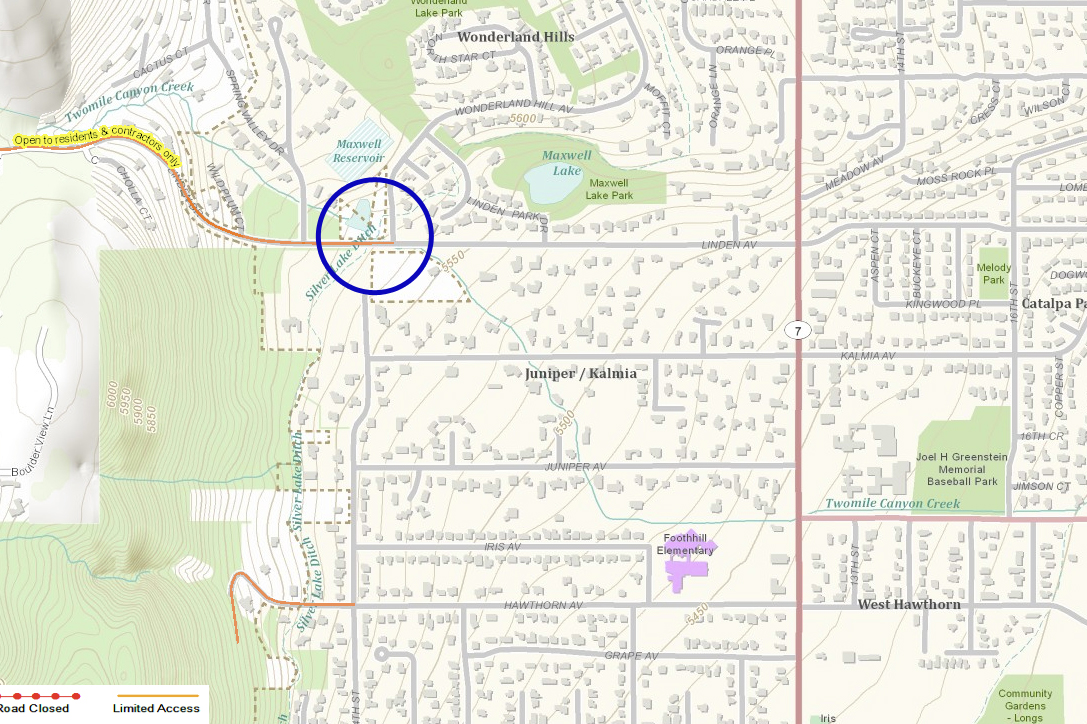
A look at the interactive map of the Office of Emergency Management shows why.

Wonderland Hill at Linden map

I’ve drawn a circle around the intersection of Wonderland Hill and Linden. Notice the blue creek line flowing to the southeast, arriving at—guess where—Broadway and Iris. This is apparently the historic creekbed of Twomile Canyon Creek.

But look at where Twomile Canyon Creek has been trained to flow instead. This is from the same map, zooming out:

Twomile Canyon Creek culvert

The straight blue line running northeast is a culvert. Twomile Canyon Creek has been diverted from its historic creekbed. In the first map above, look at all the houses in the way of its historic flow. I suspect all those houses experienced massive amounts of water. When Twomile Canyon flooded, the puny culvert at Linden and Wonderland Hill was no match for its engorged flow. Water will win.

You might say that in this part of town, we’re not respecting the flow of water. On Boulder Creek, the shining exemplar creek of our town, water by and large gets to have its say. But on many of the other creeks flowing out of the hills through our town, water has been channelized and culverted. Out-of-sight water has led to complacency in development. Land has been filled in and structures built in the direct historic paths of water.

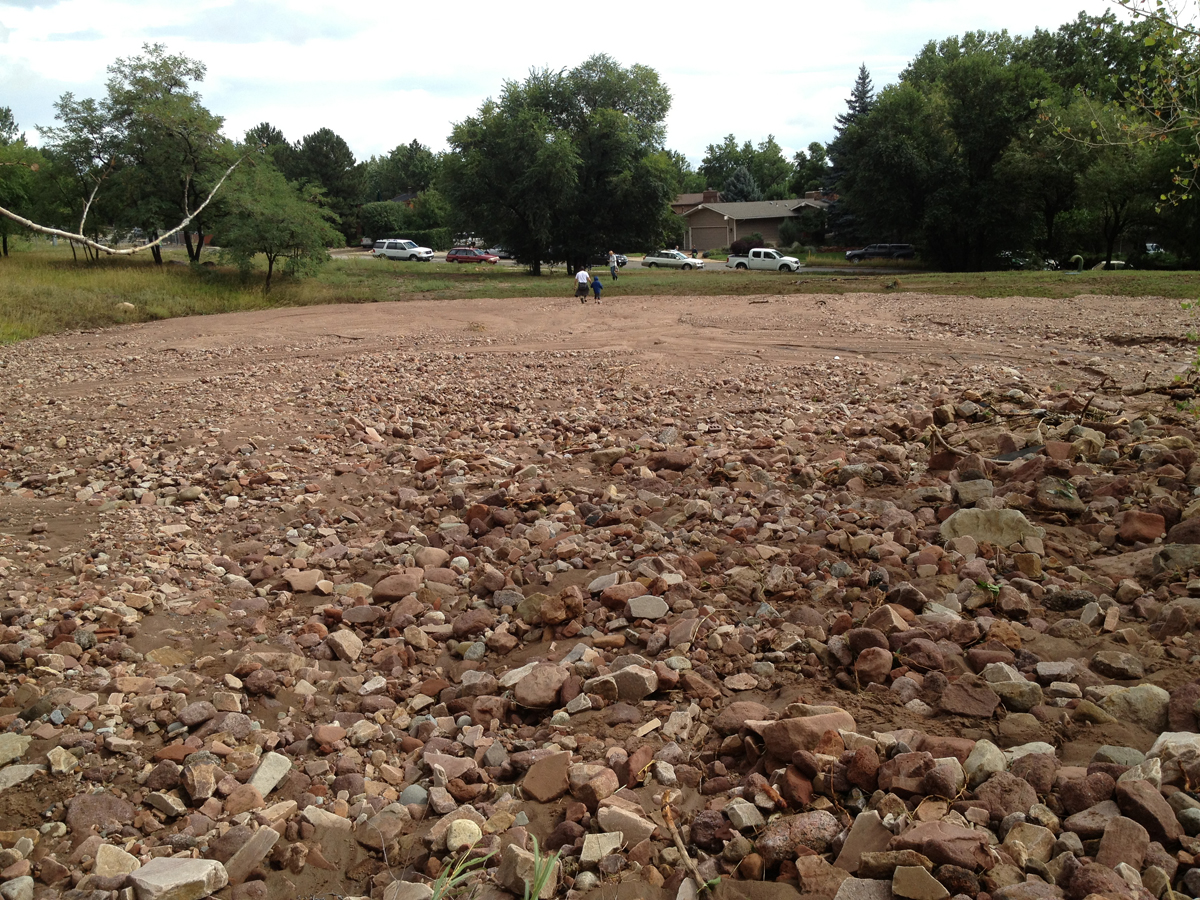
We forgot water’s power. In the first map, I drew the circle to encompass a little body of water at the intersection of Wonderland Hill and Linden, an overflow pond perhaps eighty feet across and fifteen or twenty feet deep, designed to contain the water so it won’t flood as it enters the culvert. The holding pond sits on one of my dog Bodhi’s favorite walks through the ‘hood. We’ve passed it hundreds of times. Most of the year it is completely empty, a huge depression in the ground. Here is what the raging Twomile Canyon Creek did to that overflow pond:

 Holding pond with silt

Filled it solid with rocks and silt carried down from Pinebrook Hills.

Water will win.

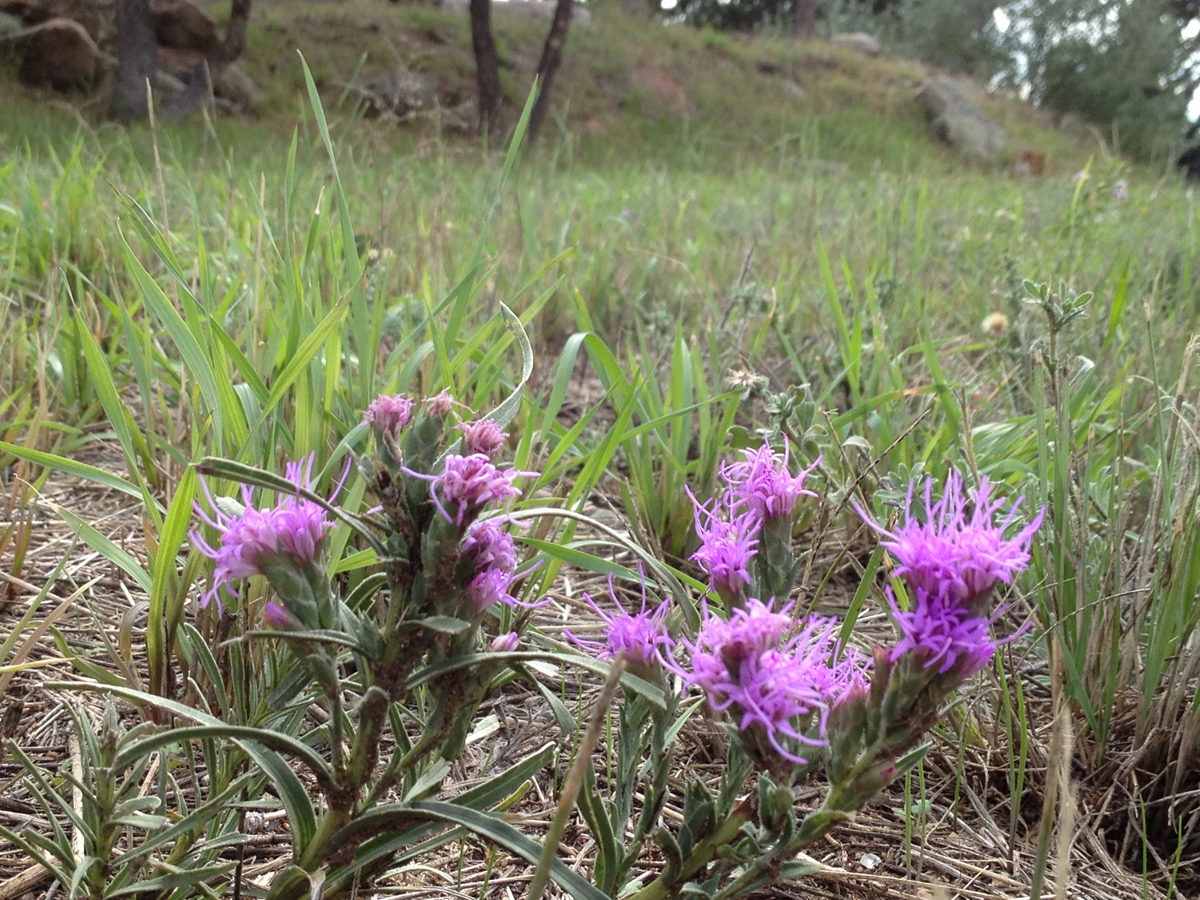
And yet there is beauty too in this unusual fall event. I’ve been savoring the greening of the grass, the freshness of the air, as if in September we’re getting the dose of springtime that we missed in April during all that snow. How many times do you get to see fall flowers, like this dotted gayfeather, not surrounded by glowing golden grass as it usually is, but instead bathed in green?

Dotted gayfeather in green

Only after heavy autumn rains.

Only a handful of times in a hundred years.

Update 2015: See this Boulder Camera article for meteorologists’ reassessment of the links to climate change: there was a good chance that the severity of this storm was exacerbated by warmer ocean temperatures and higher amounts of water vapor in the air, both linked to human-caused global warming.

Posted in nature | Tagged , , , , , , , , , | 4 Comments