Kissed by a Fox wins a WILLA Award!

Among book awards, the WILLA celebrates outstanding literature of women and girls in the American West.I’m thrilled to announce that Kissed by a Fox just won the 2013 WILLA Award in creative nonfiction. This nationally recognized award is given annually to “honor the best in literature, featuring women’s or girl’s stories set in the West.” Deep thanks to Women Writing the West, the group that sponsors the program.

When I sent Kissed by a Fox out into the world, I knew we were taking some chances. Would it be classified memoir or nonfiction? Which of the two was it anyway?

Some people, I knew, would be drawn to the memoir side of it—stories of Sapphire the wise dog or Brio the querulous cat or Rudy the red fox, who licked the inside of my mouth—but would skip over the nonfiction sections. Others might enjoy having their brains tickled by thinking about how Western civilization’s attitudes toward nature developed but wouldn’t care to hear about the author’s life at all. Still others might be put off by the very heart of the book, the connecting-with-nature experiences that break the mold of what we usually think is possible in the world. Then there was that title, which didn’t really tell readers, as a title is supposed to do, exactly what they would find in the book.

(Though my qualms about the title were answered just a few days ago by one of my most rational and skeptical readers, who countered, “A story about the trust and respect that made it possible for a fox to lick your mouth? I think that’s exactly what the book is about.”)

Underneath it all, my intention in writing was to create a piece of literary nonfiction, and to have the book recognized in that way is more deeply satisfying than anyone can know.

I want to give a huge shout-out of congratulations to other WILLA winners and finalists. My friend Barbara Richardson, also from Boulder, is a finalist in historical fiction for her wonderful novel Tributary. The book traces a nineteenth-century woman’s journey toward the heart of community, a journey that many women know is fraught with perils—communities that don’t match the best in their members, loneliness in the midst of or outside of a community, relationships that take unexpected turns. The people in Barbara’s book talk in spot-on dialect—and it’s so fresh and so witty that more than once a turn of phrase stopped me in my tracks and I sighed, “How does she do that?”

Another Boulder-area winner is BK Loren, whose novel Theft won the WILLA in contemporary fiction. I haven’t met her or read the book yet but am looking forward to both. BK’s book is also published by Counterpoint, which gives my fine, author-friendly publisher two WILLAs this year.

The WILLA Award is named after the great American novelist Willa Cather, whose stories of women working out their lives in the American West began began captivating me in my twenties. Cather touched on themes and places that were dear to me—a musician’s quest in Song of the Lark, the sweeping red rock country in Death Comes for the Archbishop, a woman’s heart in O Pioneers! Her lyric, contemplative style gave me a place to rest. I couldn’t be more thrilled that Kissed by a Fox is recognized by a program that bears her name.

So what’s your favorite Willa Cather novel? And how old were you when you discovered it?

Posted in book, nature, writing | Tagged , , , , , , | 8 Comments

Wordless Wednesday: Crazy beautiful

Columbine wildflowers against mountain peaks

Posted in nature | Tagged , , | Comments Off on Wordless Wednesday: Crazy beautiful

Does beetle kill contribute to forest fires?

Beetle Kill at Williams Fork. Photo by Jeffry B. Mitton. Bark beetle forest fires?

Beetle-killed forest in Williams Fork Valley, CO. Photo by Jeffry B. Mitton.

Pine-bark beetles are decimating forests throughout the West. At the same time, we’ve had intense forest fires recently in Colorado and Arizona. What is the connection between bark beetles and forest fires?

Most people assume there is one. It seems intuitively obvious: dead wood burns better than green wood, so a dead forest, such as in the photo above, must be more flammable than a live one.

After my recent post on the Flagstaff Fire, an alert reader commented on the supposed link between forests killed by pine bark beetles and our current epidemic of intense fires. I’d heard something quite different from Jeffry Mitton, an ecologist at the University of Colorado, so I responded that beetle kill is likely not a large factor in current wildfires. Mitton had said in a lecture I attended that forest fires owe a lot more to drought than to beetles. Drought is behind both fire and beetle kill, he explained. (The best way to prevent beetle kill is to keep a tree well watered; the tree uses its liquid pressure to expel beetles when they first attack.)

A dry green forest is extremely flammable because each tree is full of sap, which is an explosive fuel. Mitton said that a dry green tree is the most flammable thing in the forest. When beetles hit a green forest and kill the trees, the trees first turn red as their needles die, and then gray after the needles drop. A red forest is also extremely flammable because of all the dead needles on the trees. But once a section of forest dies into gray and the sap is no longer present, trees can no longer explode and send sparks to their neighbors, and a fire has a harder time spreading. Mitton said, “Fire does not propagate through a gray forest.”

Surprised by this info, the reader quoted this study, which suggests that the intensity of the fireline is 4 or 5 times higher in beetle-infested forests and 6 to 8 times higher in beetle-killed forests compared to forests that have not been touched by beetles.

I asked Jeffry Mitton to comment on the study. Mitton looked at the study and noticed three things:

(1) It has not been reviewed by anonymous reviewers.
(2) It is not published.
(3) It is based not on observations but on applying a model to some rather arbitrary data.

Right, the peer-reviewed test—where a paper is sent out to anonymous readers well versed on the topic, who examine the study to see if it followed standard protocols and the most reliable methods. If it didn’t, then the study’s results cannot be trusted and the paper is not published. In effect, it doesn’t give us true enough information about the world. This study was not peer reviewed and so should not be given as much weight as those that have been anonymously reviewed and published.

Mitton’s third point is also important: this is an argument from a model, not from actual measurements. The authors are saying that based on what they know about fuel and treetop mass and how fire acts, a fire in beetle-killed forest should have a certain intensity, and that intensity should be higher than in a noninfested forest.

But is it true? Do forest fires actually act like that? The study doesn’t address this.

Mitton said,

If the results of that paper were correct, why have we not seen any big fires . . . around Steamboat, Vail, and Dillon? If beetle kill is such a threat, then we ought to be able to list the immense fires that have followed the beetle in this epidemic, and in previous epidemics. Those fires have not occurred. The fires in the West occur in green forests suffering drought conditions.

Mitton took the above photo recently in the Williams Fork Valley, in north-central Colorado. There are miles of such beetle-decimated forests at higher elevations stretching from Colorado to British Columbia, which has been hit particularly hard. Mitton said,

In BC, this type of landscape stretches for miles and miles and miles. I have not heard of any fires torching these landscapes. And remember, these landscapes have been around for a while now, for the epidemic began 13 years ago in BC.

Interestingly, while this email conversation was going on, an article in the Boulder Daily Camera quoted researchers who also dispute the conventional wisdom that beetle-killed forests are more flammable. Monica Turner, a forest fire researcher of the University of Wisconsin, said,

I think that one of the reasons that this seems counter-intuitive to people in terms of its effect on fire is that when we burn a fire in our fireplace, we put dead logs in there—we don’t put green branches. But in a forest fire it’s those green needles that are extremely flammable.

It’s why you don’t ever want to burn your Christmas tree in a fireplace. Those needles flame and flash like crazy. (I saw the effects above one fireplace—smoke damage up the stone facade on the wall, reaching all the way to the high ceiling. No, it wasn’t my fireplace, thank goodness!)

You might think of a beetle-killed forest as a set of needle-free logs in a fireplace spaced out so they’re barely touching. It’s not easy to keep that fire going even if you try. To feed a fire, we stack the logs up. To kill it, we spread them out. Dead trees in a forest, with no needles and spaced evenly apart, cannot easily conduct fire to one another.

It appears that drought is a much bigger contributor to forest fire than beetle kill, as another recent Daily Camera article shows. And that means higher risks of fire as climate change advances.

Climate Central is a research center that recently released a graphic to show the relation between early snowmelt and forest fires in the West. You can check out the interactive web map here. Alyson Kenward, a senior scientist with Climate Central, summarizes what it shows:

Years with higher temperatures in spring and summer and lower snowpack tend to be the years with the most fires.

So our increasing rate of forest fires has a lot more to do with climate change and drought than they do with beetle kill. Knowing this won’t change the path of the beetles, but it may allay some fears about where the beetles have been.

Posted in nature | Tagged , , , , , , | 8 Comments

News about Kissed by a Fox

I’m thrilled to announce that Kissed by a Fox recently won two book awards.

Nautilus Book Awards medalThe Nautilus book awards celebrate “Better Books for a Better World,” and Kissed by a Fox won the 2013 Nautilus Silver Award in the category Animals/Nature. Some of my favorite writers and personal heroes are Nautilus Award winners, including Barbara Kingsolver and Thich Nhat Hanh. I’m delighted to be part of a long list of books that “stimulate the imagination and inspire the reader to new possibilities for a better world.”

ForeWord Book of the Year Book AwardsForeWord Reviews is a publication that goes out to libraries and booksellers everywhere, alerting book lovers to great offerings from independent, university, and small presses. I am delighted to announce that a few days ago at the annual American Library Association conference in Chicago, Kissed by a Fox was awarded the ForeWord 2012 Book of the Year Silver Award in the Nature category.

In more good news, the book just went into its second printing, and we’re celebrating with an updated cover that looks like this:

The Nautilus medal will appear on the front, along with Temple Grandin’s words: “Kissed by a Fox will make you think about life and nature in a different way.”

The new cover is at the printer, and I’m told that the new books will be delivered this week. You can find them soon at your local bookstore.

Thanks to all of you who have read the book and alerted your friends to its presence in the world. With your help, the word is getting out!

Posted in book, writing | Tagged , | 6 Comments

A year after forest fire

A year ago today, the Flagstaff Fire roared across the mountaintops at the western edge of Boulder. Down below, we anxiously followed the plume of smoke, tracing the widening circle of flames across the peaks. Was this the big one, the fire that would catapult itself on the wind down into the city? Aggressive fire response from all departments in the region laid our fears to rest. The fire smoldered and burned out, and no embers skipped into town.

Seven weeks later, Dave Sutherland toured the fire zone and offered this photo essay.  Even after only seven weeks, some plants had roared back, not only sprouting leaves but also in that short time sending out flowers, which attracted insects, who in turn attracted birds. Woodpeckers were busy combing blackened bark for roasted bugs; new life was flourishing in the fire zone.

It’s been a year, and how does the fire zone look now? Recently I had the rare treat of seeing the mountaintop without enduring most of the climb to get there. Dave organized a special hike for nature educators, driving us up almost to the edge of the burn area.

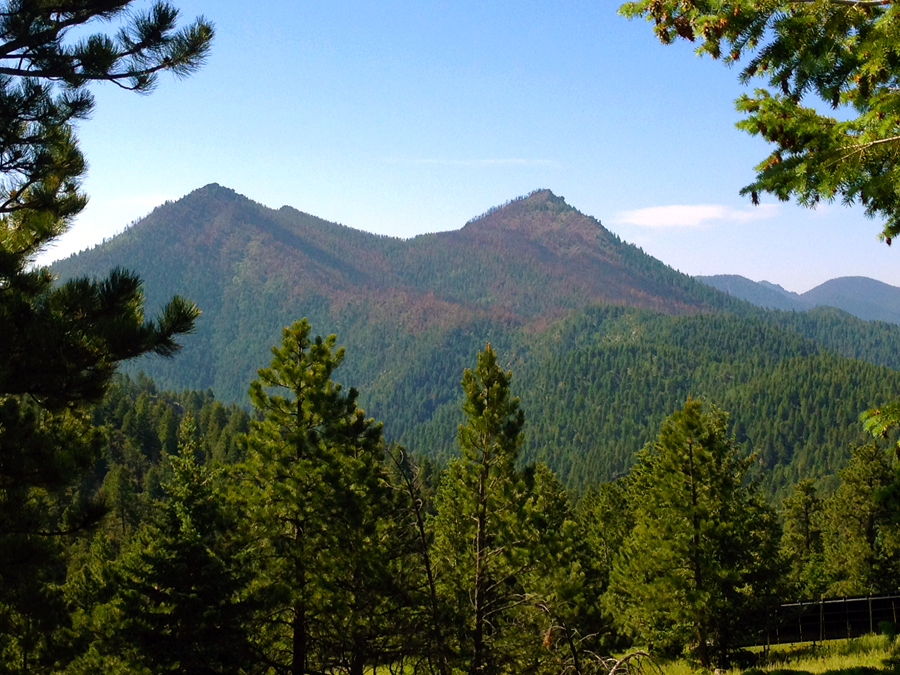
On our way up the mountain we stopped along one of the fire roads and took a look from a distance at the burn. Even on a hazy morning we could see that the fire had traveled a Y-shaped path up the west ridges of Bear Peak, on the left, and South Boulder Peak on the right. The saddle between the two mountains saw much less fire and remains green.

The Flagstaff Fire created a Y-shaped fire zone.

Fire loves to go uphill because the heat rises ahead of the flames, parching the ground and preparing it for combustion. Once the flames crest a hill, they have a much harder time moving down the other side, which is why a year ago today, Boulder faced a larger danger by far from wind. Gusty winds could have deposited embers in the heart of town; it was a lot less likely that the fire would march straight down the Flatirons.

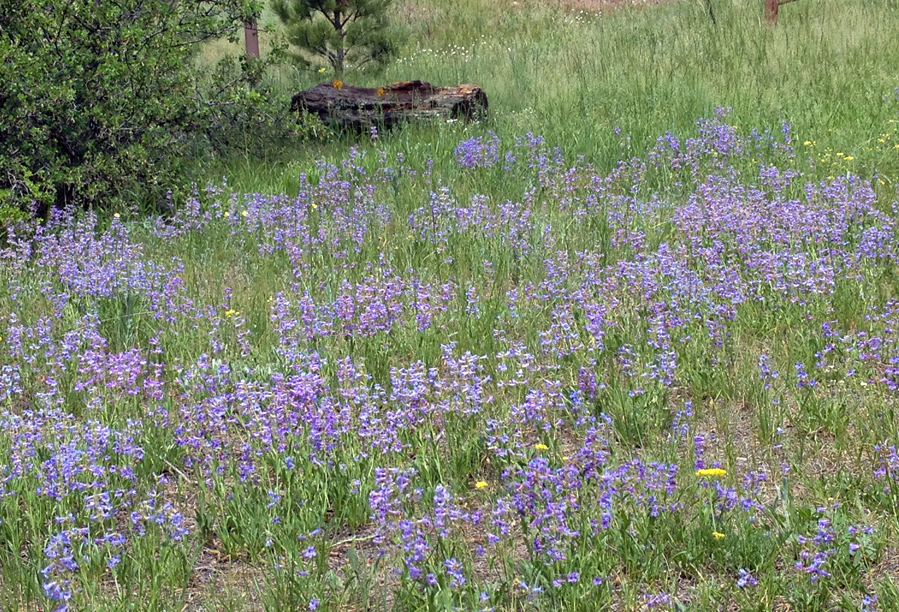
Near the fire zone, we climbed out and admired the carpet of blue mist penstemon.

Penstemon outside fire zone

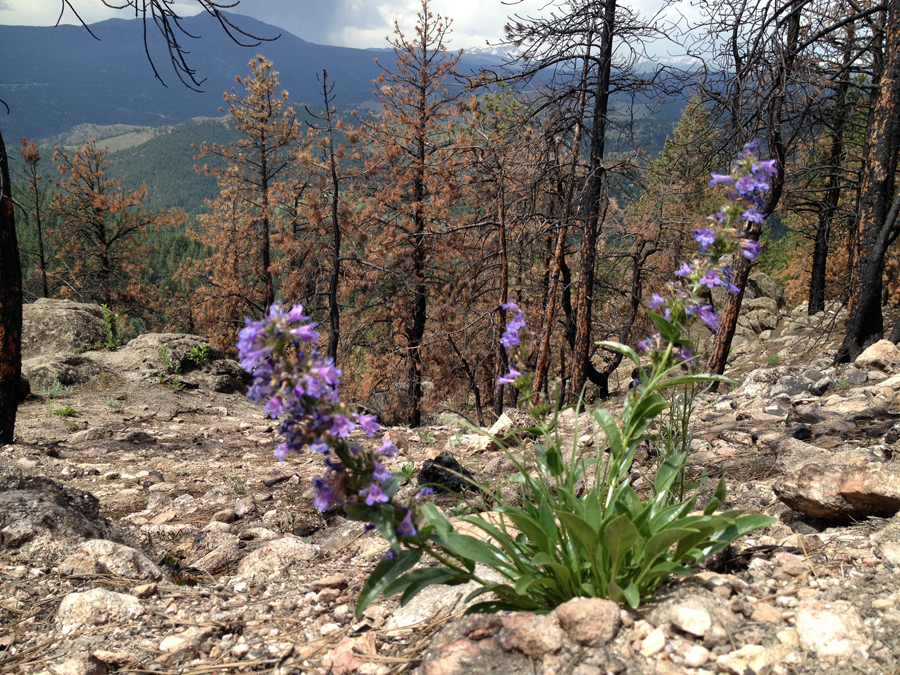
The scene changed just a short distance up the hill. Inside the fire zone, penstemon were blooming again, but only a few of them. Penstemon roots are 6–9″ long, which shows that the fire was not hot enough in this particular spot to disturb the roots of every plant.

Penstemon in fire zone.

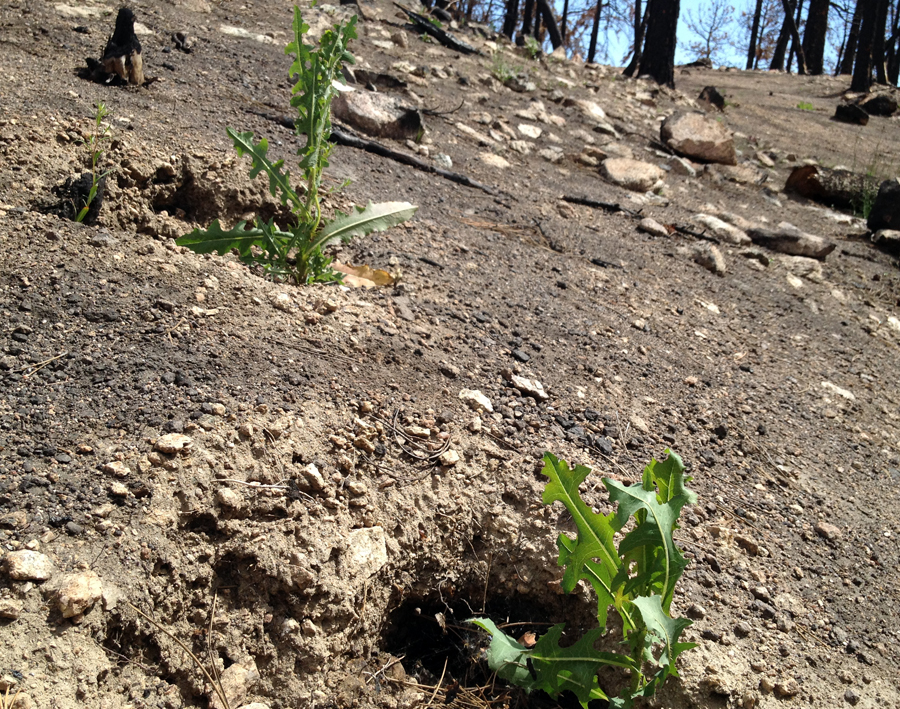
Yet turn around, and we saw behind us two holes in the ground—only a memory of two young ponderosas. In this spot, the fire blazed hot enough to vaporize even the roots of the trees. Each cavity is now adorned with a sprig of the invasive prickly lettuce.

Even the roots of trees were vaporized in parts of the fire zone.

If the ground looks charred, it also shows a great deal of fresh green. Much of the earth is covered with a patchy layer of new plants and flowers.

Ground cover

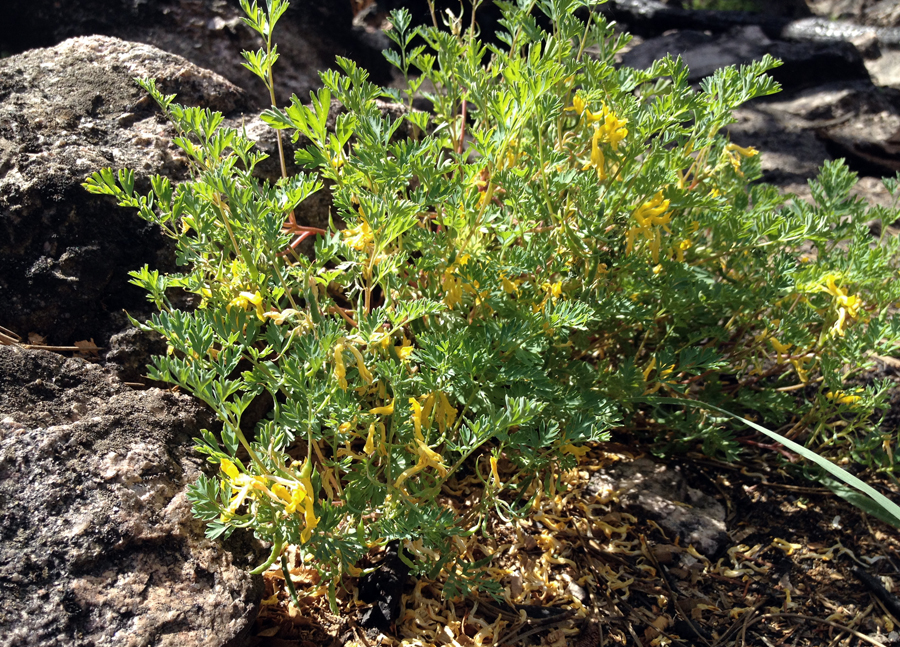
Perhaps my favorite from the morning was golden smoke (Corydalis aurea), the only flower of its family to grow in Colorado. Before the fire, golden smoke was not common around here. Now it is springing up everywhere in the fire zone. It prefers light shade and forest clearings, which explains why when this forest was cleared by fire, golden smoke seized the day.

Golden smoke plant newly flourishing in the fire zone.

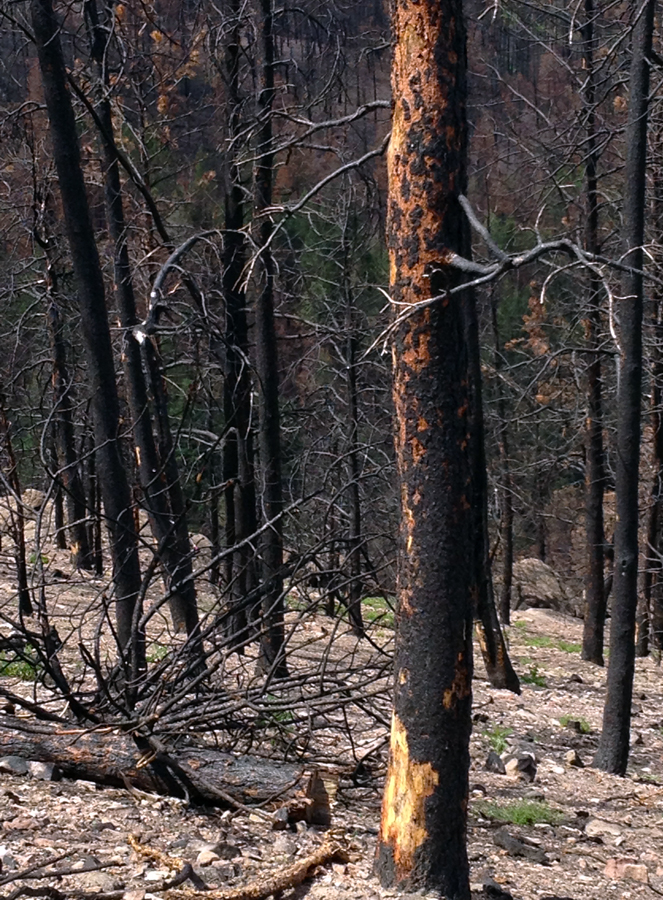
Dave pointed to a blackened ponderosa pine. “See the patchwork on the bark?” he asked. “Woodpeckers do that.” After a fire, he explained, woodpeckers pick a spot on a burned trunk and get busy, flipping pieces of bark left and right as they search for bugs underneath. Pretty soon the blackened tree is a mosaic of black and tan.

Ponderosa bark stripped

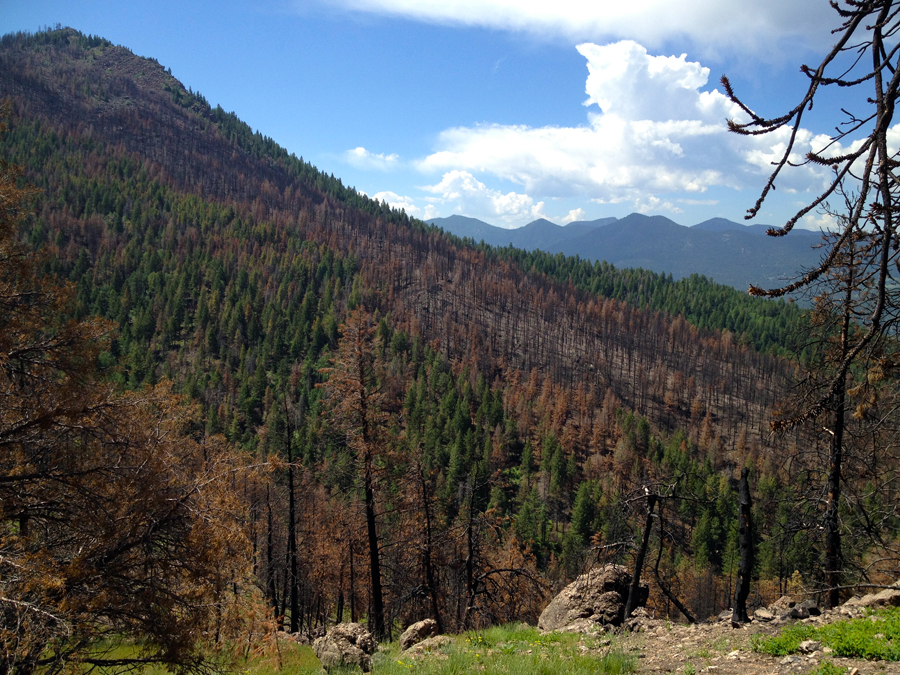
Perhaps the biggest message Dave wanted us to take home was the patchwork nature of a forest fire in general. “Look out on that burn area,” he urged. We looked out on a variegated scene. Browned and blackened trees alternated with live stands of ponderosas as far as we could see.

Forest fires help biodiversity, burning in patchy patterns.

“A forest fire helps biodiversity,” he said. “It opens up areas of the forest floor that have been shaded for decades. And it releases some species to grow in places where they have not grown for years.”

He pointed to a tiny clump of aspen hugging the ground. “Aspen trees have been crowded out of this hillside by ponderosa shade for the past sixty or seventy years. Now the ground is opened up, and the aspens have a chance to repopulate this hillside. In another decade this side of the mountain will likely be covered with aspen.”

Because the effects of a fire are spotty, a fire in a ponderosa forest reduces the monoculture of the forest, encouraging new species of plants—and therefore insects and birds and animals—to emerge. A fire supports nature’s endless thirst for variety. And since a diverse landscape is usually a more resilient one, a forest fire promotes the long-term health of the local ecosystem.

I’ve met people who can’t bear to walk in a burned forest. It’s too painful, they say. No green to look at, only the ruined skeletons of trees. I have a different view. A burned forest may not refresh like a green one, but a burned forest tells a story—a story of change and opportunity, a story of starting over that may appeal if you’re a pioneer. It’s a story I find as enlivening in its own way—and a lot more bracing—than the nourishing beauty of lush green land. In a burn zone, one walks the knife edge between life and death.

But like the desert, a burned forest is best taken in small doses. That morning our hike was cut short by threatening clouds and rumbling thunder. Instead of remaining near the peak of the mountain to tempt lightning, we retreated below to sit and talk among the penstemon.

Leaving the charred forest early was fine with me. I felt relieved to get back among green things, to breathe deeply and relax.

And I was grateful all over again that a year ago today, the wind did not carry embers on that very short path into the town below.

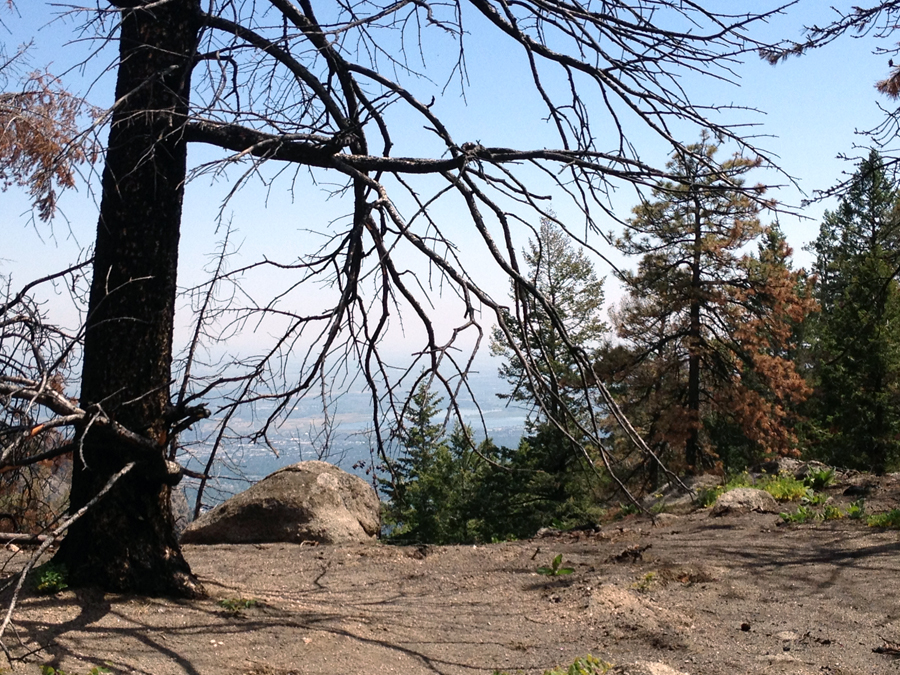
Overlooking Boulder

Posted in nature | Tagged , , , , , , , | 16 Comments