Living with Bell’s palsy

I am caught up in a new adventure, the kind no one ever bargains for.

It began a week ago with a dry and scratchy left eye. Why was it tearing so much? The next morning I awoke to a muscle tic in my lips. Twitch. Twitch-twitch. I pulled out my phone and turned the camera to my face. The left side was not working like the right.

Alarmed, I popped out of bed. Was this my whole face or just one side? Was I having a stroke? I checked arms and legs—fine, at least so far. On the way to the bathroom I grabbed my phone in case I had to dial 9-1-1. (My sweetheart was still sound asleep.) At the mirror I tested face muscles—smiling big, squinching eyes. Definitely less movement on the left.

I paused to see if paralysis was spreading. Arms and legs still fine. It was only affecting my face. It likely wasn’t a stroke.

I was only partly reassured.

A few minutes on Google led me to Bell’s palsy. Affects 40,000 people a year in this country, 1 in 65 in a lifetime. Most likely temporary, though it takes a long time to heal.

The cause? No one knows for sure. For some reason—maybe a virus like the ones that cause shingles and Lyme disease, maybe trauma—the facial nerve on one side becomes inflamed and then dies. Face muscles lose their signals and fall dormant. In most cases the nerve regenerates without treatment and the muscles come back to life. But because nerve tissue grows only a millimeter or two per day, the process can take weeks. Or months.

Over the next couple of days paralysis settled into my face. Eating became harder; so did drinking. Sometimes water dribbled down my chin, other times I choked. Without cheek muscles, forget sucking on a spout or a straw. While chewing, I bit my lip then bit it again. Kissing my sweetheart turned into a lost cause. Or half lost. The left eyelid no longer closed completely, so I needed to blink long and hard, every time. I began propping my cheek in my hand, holding the eye half shut to keep it comfortable.

Luckily my life these days is a quiet one, my work taking place from the comfort of my desk. I could talk to clients on the phone just fine, as long as I worked a little harder to enunciate.

I rested more, finding I often needed an afternoon nap. So much extra work wears you out, you know?

I visited a massage therapist. She placed her hands gently on my scalp, listening. “Did you bump your head recently?” she asked.

Why yes, I did. Two months ago a renegade casserole lid—heavy, glass—slipped off its base while I was placing it on a top shelf. Next thing I knew I had a half-inch gash at my widow’s peak, and the hand that I pressed to it was dripping in blood. (The gash healed fine without stitches.)

“Your suture joint isn’t moving like it should,” the massage therapist offered.

I returned to Google to learn about the skull and the facial nerve. This nerve is one of a dozen cranial nerves, meaning that it originates within the skull in the brain stem, not in the spinal cord. Cranial nerves have to make their way out of the skull, and the facial nerve slips through a tiny hole just below the ear. These photos helped me understand the peril the facial nerve is in if it ever gets inflamed and swells. No room to expand. Damage will be done.
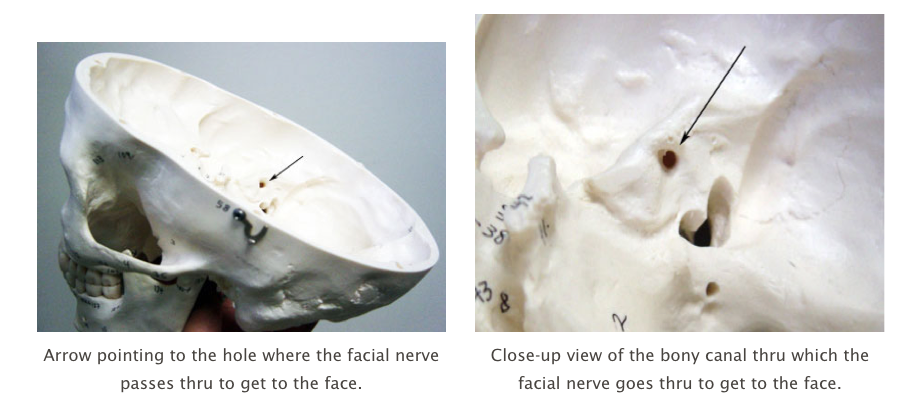
From http://www.fauquierent.net/facialparalysis.htm

From http://www.fauquierent.net/facialparalysis.htm

Did the bump on the head displace my cranial bones just enough to put pressure on the facial nerve? I may never know. It’s a good theory, though.

As the days go by, I find myself adjusting. I pay more attention—a lot more—when eating and drinking. A little lip motion has returned, so my mouth can actively kiss my sweetie a wee bit more, though he still encounters limp-fish lips, I’m afraid. Lucky me, he doesn’t seem to mind. After one day of searching out my new face, he adjusted to the changes and didn’t give me a second glance. In a good way, I mean. No extra attention, the unwanted kind.

The bigger adjusting is taking place inside. My sense of loss has deepened as the days go by. One moment I barely notice the impairment; the next I feel like chopping heads. Grief has moved in like an unwashed roommate, one I hadn’t needed to make space for in a while.

I find myself thinking of friends whose bodies were injured. My paraplegic athlete friend who water-skis, bikes, skydives, and beats me at Words with Friends. The photojournalist friend who died of ALS last year, a high-spirited woman who cracked jokes during all the years we watched her lose the ability to move her feet, then her hands and arms, then her eyes. The orchestra conductor in college who, after a surgery near his ear, returned to the podium with slurred speech and a half-working face, his verve for the music undimmed. The cousin across the country who in high school nearly died from a fever that left her muscles jerky, who went on to get married and raise a family, including twin boys, and is now enjoying her grandchildren.

I find myself sending a silent thanks to each one—for dealing with what life handed them. For adjusting to what is possible. For enjoying their life whatever shape it took. It is a powerful thing to watch someone enjoy life—and I am grateful to each one for finding the equanimity to do that. I imagine it took some work.

I send each of them a thank-you especially for being themselves no matter what. Because a deeper layer here is how I see myself, and how others see me. Getting your face moved around without your permission is, at best, unnerving. (Literally true this time!) Now I hesitate a bit before going out in public—and I have some very public events coming up soon, like a radio interview and a book reading. Will I be brave enough to do them? Will I have the energy? I guess we’ll find out.

A spiritual path has a lot to say about becoming disfigured, even temporarily. My own path is teaching me about looking below the surface for what’s real instead of stopping at appearances. In a meditative journey this week one Spirit Helper observed that modern culture, unlike more Spirit-centered cultures of the past, looks almost entirely on the surface of things, prioritizing how people look, and that one gift of this facial challenge is that I, who can get caught up in that tendency (it was clearly said) am being invited to rearrange my priorities and live a freer life. The words were offered gently, but I got the point. (Concerned about appearances—what, who, me?) This same wise friend added that anytime priorities get rearranged, feelings of grief will arise.

My spiritual path has provided comfort too. The day I came down with this malady, but before I knew it was happening, in a meditative journey I was shown the joy that bubbles into physical reality out of its mysterious, hidden source. From the tiniest plants in the garden to the body of each person to every point in outer space, reality boils over with rollicking, roiling joy; each body is its visible presence, each of us its outgrowth. Joy is the switch that turns us on at the start, joy the fuel that grows us, and joy the creative fingers that stitch together all wounds, from the scar in the tree bark to the intricate human heart.

It was a marvelous picture, and I have returned to it time and again this week. I believe it was given for that purpose. When feelings of sadness and loss arrive, I attend to them, and they pass. And when they pass I root myself again in growing things; I see again their source in irrepressible joy.

This is, after all, how nature heals—by offering its flow of unstoppable creativity, its endless gleeful variety, its untamed urge to generate and grow.

I suspect the closer I live to this source, the more easily a facial nerve will regenerate.

Oh, and it doesn’t hurt to know that George Clooney had Bell’s palsy once. For nine months. In ninth grade, poor guy.

Posted in nature, spirituality | Tagged , , , , , , | 23 Comments

Thanksgiving and peace

Thanksgiving plateOn Sunday we hosted a Thanksgiving potluck, and before we sat down to eat I offered a grace that I’d been working up courage for twenty years to offer. I thanked the animals and plants who gave their lives and their labors and their fruits to feed us.

It is the quiet way I begin every dinner—picturing the animals and plants when they were alive, thanking them, thanking the sun and the Earth, thanking the Mystery or Great Spirit, whose living currents flow through all of us, and finally thanking my sweetheart, Tim, for cooking the food and bringing it to the table. (Lucky me—my sweetie cooks!)

This time at our potluck table I also thanked the people who labored in the fields. I was remembering a mindful-eating meditation I learned some years back at a meditation retreat: the raisin meditation from Jon Kabat Zinn, in which by really looking at one single raisin and slowly tasting it, we slip without effort into more wakefulness and gratitude. The raisin meditation at the retreat was combined with an interbeing meditation inspired by Thich Nhat Hanh, where in addition to savoring one raisin, we focused on all the people who had tended the grapes in the fields and picked them and transported and dried and packed them before this single raisin could reach our lips. Remembering interbeing, in my Thanksgiving grace I said, “This ritual of eating connects us with all others—all the plants, all the animals, all other people, with sun, sky, and earth.”

The practice of thanking plants and animals who feed us is an ancient one among many indigenous traditions. I think of the Thanksgiving Address of the Haudenosaunee (Iroquois) of the eastern Great Lakes areas, which I read this week for the first time just a few days after our potluck feast. The title of the Thanksgiving Address translates to “The Words Before All Else,” and the Haudenosaunee offer it at the opening and close of every gathering, civil or religious, as well as at the beginning of every day at sunrise. (You can download it here from the National Museum of the American Indian.)

Each paragraph of the Thanksgiving Address thanks one set of creatures in the natural world. For example:

We now turn our thoughts to the Trees. The Earth has many families of Trees who have their own instructions and uses. Some provide us with shelter and shade, others with fruit, beauty and other useful things. Many people of the world use a Tree as a symbol of peace and strength. With one mind, we greet and thank the Tree life.
Now our minds are one.

We put our minds together as one and thank all the Birds who move and fly about over our heads. The Creator gave them beautiful songs. Each day they remind us to enjoy and appreciate life. The Eagle was chosen to be their leader. To all the Birds—from the smallest to the largest—we send our joyful greetings and thanks.
Now our minds are one.

Though the basic pattern of the Thanksgiving Address never varies, when someone recites it, they may elaborate on any of the creatures as they wish, depending how they feel moved that day, as Whatweni⋅neh Frieda Jacques, Turtle Clan of the Onondaga Nation, explains to the young Kateri Riley Thornton, Snipe Clan, in this video:

I have read that at large Haudenosaunee Peacemaking gatherings of the past, reciting the Thanksgiving Address might take up the first twenty-four hours or more!

The Haudenosaunee say that thanking all other beings is necessary for living in harmony and peace. For if we don’t recognize and appreciate the gifts of others, how can we have peaceful relations with them?

The refrain “Now our minds are one” shows what happens in a group when people practice being thankful together. Each person’s mind quiets and comes to center; each person’s heart opens. I can’t think of a better way to foster wise decision making in a group setting.

Thanking the rest of the creatures is also a fundamental way to orient ourselves—to know where we are. As Kahionhes John Fadden, Turtle Clan of the Mohawk Nation, said,

The first thing that’s done is you give thanks to everything. You thank the waters beneath the Earth, the stones, the soil, all the way up to the stars. It’s just a reminder of where we are. We should never forget that.

What better way to open to this place, this moment?

If each of us did this every day, the world would change. It would have to. The late Tekaronieneken Jake Swamp, Subchief of the Mohawk Nation, said,

If all of the children of the world were to be a part of this kind of Thanksgiving each day, I believe that the problems of the world would start to go the other way.
I think he was referring not just to the problems between nations but also to the problems between human creatures and the other life forms on Earth. Giving daily thanks to them is the tiniest, most personal, and powerful way to begin addressing the largest climate and ecological issues our world faces today.
So here is a challenge: let Thanksgiving become a part of daily life. Begin each day by thanking the Earth and Plants and Animals and Winds and the Sun, Moon, and Stars for their gifts. Thank the Creator (or God or Mystery or however you know the Source) for flowing through you and everything you see and touch.

Today, the first day after Thanksgiving, is a wonderful time to start!

Posted in nature, spirituality | Tagged , , , , , , , , , | 5 Comments

Who’s in the native garden?

In my June 2 post about restoring our Santa Fe yard with native plants, about ten days had passed since sowing a dozen pounds of grass and wildflower seed, and the first tiny sprouts were beginning to appear.

purslane 6-2-14Those first shoots, alas, were nothing I had planted; they were purslane (Portulaca oleracea). Purslane is an amazing grow-anywhere plant, a succulent brought by Europeans to provide salad greens in wintertime (it dries nicely). When it grew bigger I sampled it—what a great taste! Slightly salty, with a definitely satisfying crunch. And more omega-3 fatty acids than any other leafy vegetable. Any!

I didn’t want my yard covered in purslane, but yards have their own ideas, so purslane took over. Millions of sprouts. Later I was grateful for the ground cover—holding down the dust through a dry June. Purslane knows its job. The native grasses, blue grama and buffalograss, are warm-season grasses, which means that in this cool-ish spring they waited a long time, until mid-June, for the soil to get toasty before they germinated. When they did sprout, they had to pick their way skyward through purslane.

grass in purslane 7-13-14Native grasses can hold their own, so I held off weeding.

By the end of June, after watering twice a day for three weeks then once a day after that, I could see honest-to-goodness patches of grass where before there had been none.

yard growth 6-28-14In July the yard suddenly went crazy, thanks to the returning monsoons—an almost-daily afternoon or evening thundershower. Rain in the desert! Here’s the same patch just two weeks later, around mid-July:

native garden with fresh grass 7-13-14Rainwater truly is better for your yard, and a big reason is that it is not chlorinated. Chlorinated tap water kills the microbes in the soil for 24–48 hours after watering, and it possibly also disturbs the balance of beneficial microbes in the human gut.

With all the fresh rain, the yard bloomed with native wildflowers—some I’d planted in May, others longtime residents. Mexican hat (Ratibida columnifera) at dawn:

Mexican hat in the native garden 7-19-14Chocolate flower (Berlandiera lyrata), whose foliage is said to be tinged with the scent of chocolate, though I’ve not been able to smell it:

chocolate flower in the native garden 7-30-14Chocolate flower is pretty even after blooming, for it shapes its seed heads into rosettes:

chocolate flower rosettesAnd of course the penstemon—perhaps the most prized native flower in Santa Fe, large and ubiquitous and many shaded from purple to red and orange, glowing in the most arid soil along walls and fences from April through July. Here, in a moist spot in our yard, is a purple variety:

penstemon in the native garden 7-30-14And a tiny mystery flower, which I’ve not yet had time to identify—small as a fingernail:

mystery flower 7-17-14Around mid-July the blue grama suddenly began to flower, its feathery seeds glistening. The mnemonic for blue grama is “gramma’s eyelash,” for obvious reasons:

blue grama stem 7-13-14Every morning blue grama seed heads glistened in the golden light of dawn—a magical sight that I enjoyed afresh each day but couldn’t quite capture in a photo. How to convey the feeling of a mass of florescences twinkling in the breeze? For days I spent an hour each morning with my belly in the dirt, trying every possible angle. Getting up close helped me get to know blue grama, and finally the photos began to come alive:

blue grama 2 7-30-14We also have a few bunches of Indian ricegrass (Oryzopsis hymenoides). The Indians, I am told, gathered these minuscule seeds and processed them into food:

Indian ricegrass 7-13-14By later July the garden had turned into a riot of golden hairy asters (Chrysopsis villosa) and yellow prairie coneflowers (Ratibida columnifera) and Mexican hats and blue grama:

yard flowers 7-19-14Grass even sprouted at last under the juniper tree, where there had been bare soil for several years. Here was the morning view out the window from my workstation during July:

grass under juniper 7-13-14One corner of the yard is devoted to nonnative, showy flowers on drip irrigation, and in July the flower garden went wild:

south garden 7-13-14A special joy of living in Santa Fe is getting to know the desert rose, apache plume (Fallugia). It’s a large gangly shrub of the rose family, with white flowers that look like wild roses. When it goes to seed, each flower produces a feathery plume, and July brought out the plumes:

apache plumeAnother special joy is the blue mist spirea (Caryopteris x clandonensis) just outside our gate, a chorus of bees humming in it:
blue mist spirea 7-30-14The birds love our yard, so mornings often find me sitting quietly in the garden keeping track of visitors. In July I could typically spot 18 to 20 species in an hour or so. Bullock’s orioles were frequent visitors, busy grabbing food for their new fledglings. One morning a male oriole perched briefly atop a Russian olive tree, chattering noisily, before taking off for the grape jelly feeder:

male oriole in olive tree 7-18-14Followed a few seconds later by his mate:

female oriole in olive tree 7-18-14One afternoon I heard a ruckus of chattering orioles and other chirping, angry birds and went out into the yard to find a Cooper’s hawk perched on our fence:

Cooper's hawk 7-13-14August has brought out the plains coreopsis (Coreopsis tinctoria):

coreopsis 8-10-14We said good-bye to the orioles last week—they’re the first to head south, just as soon as the juveniles can feed themselves—but have said hello to the purple flowers of late summer: the purple asters, which around here grow on bushy plants taller than your knees. They look so weedy that I made the mistake of pulling out one or two of these bushes in July:

aster 8-10-14And a special treat was our glimpse last week of a snake hanging out under the recycle bins. I believe it’s a garter snake, about two feet long with a body as thick as a man’s thumb:

snake 8-4-14What would a view of the yard be without my constant companion, Bodhi the Chief Yard Patrol and Squirrel Chaser? He hates the camera, so when he saw me fiddling with it he turned his face studiously away.

Bodhi 8-9-14The restored yard is at its peak right now. I reseeded a few still-bare spots in July, and when the rains quit for a week I had to resume watering those new seeds, but most of the time the yard is on its own, and all I am doing is watching. And enjoying. Here are a few photos from the past few days. First, the same patch of new grass as in photos above:

yard walkway 8-9-14Looking north (downhill):

yard looking north 8-9-14Looking south (uphill):

yard looking south 8-9-14Looking east, toward Picacho Peak at the edge of town (a four-mile round-trip hike with 1500 ft elevation gain; I did the hike just a few days ago):

yard looking east 8-10-14And finally, looking west:

yard looking west 8-10-14

Posted in Uncategorized | Tagged , , , | 2 Comments

A settling torch

Today is Malala Day, the birthday of Malala Yousafzai, the young woman shot in the head for defying the Taliban and daring to work for girls’ access to education. Tweet with the hashtag #StrongerThan to show support for girls’ education and for Malala’s clear, peaceful way of being. Malala says, “Together we are stronger than oppression. We are stronger than violence. We are stronger than fear.”

It was a childish slip—my sweetie, Tim, thinking his dad said “a settling torch” when he talked of an acetylene torch. But I knew Tim’s childish error was, in the ways of children, wiser than it appeared.

A “settling torch.” Two words we never put together. Hearing them side by side jostles the mind out of the usual, into new territory.

For me the words conjure an experience of awe, like watching a sunrise in springtime. The light slowly grows, faint and pink in the east. Birds begin to wake, a morning chirrup, a few tweets there, then full-on operatic trills. Watching and listening, I feel my insides grow quiet.

Dawn is so filled with awe that it stills the mind. It carries so much of the beyond that it settles me fully in the present.

Dawn is a settling torch.

People too can be settling torches. Some months ago I watched in awe as Malala Yousafzai talked with Jon Stewart on The Daily Show. Malala was a Pakistani teenager in 2012 when she was attacked by a Taliban gunman with a Colt 45 because she dared to assert girls’ rights to education.

But it’s not just Malala’s recovery from the near-lethal wound that is so inspiring. It’s the spirit with which she has responded to this attack on her life, on her human rights, on her body. Today she is loving, she is firm, she is self-possessed and eloquent. She carries renewed conviction and vigor—and a sweet and happy sense of humor. Malala is moving the world to reaffirm the universal right to education. In the wake of her assassination attempt, Pakistan passed a Right to Education act, and though it is not clear how well the bill will be implemented, it is a sign of slow and quiet progress in education in that country, especially for girls.

But back to Malala’s interview on The Daily Show. Listen at 4:30 to what she would like to say to the Taliban. Then see Jon Stewart’s reaction at 5:10. Malala is so truthful, so present and human, that Stewart’s jaw hangs open. She stops him cold! No easy feat.

So blazing with heart that we are stopped in our tracks: a settling torch is like that.

Someone who has become a settling torch is inspiring, connecting us if only for a moment with something much larger and greater than ourselves. And at the same time settling—with a simpleness that quiets and calms. Their voice startles with the big-hearted rightness of their words. They provide a glimpse of something so real and true that the only response is to fall silent. Suddenly we feel peaceful, a peacefulness that was there all along, we just didn’t have access to it.

Maybe you find your settling torch in walking beside the ocean or hiking in the forest; maybe you find it by sinking into a great painter’s vision or a poet’s words; maybe you find it in sitting on a meditation cushion or swaying to soul music. Wherever you find it, go! Do more of that! Fill yourself with whatever large-hearted vision inspires you, for only by touching your settling torch on a regular basis will you have what it takes to make that inspiration real in everyday life.

Malala is extraordinary for her jaw-dropping clarity—and for reaching such clarity so early in life. But she is not extraordinary in this sense: the path to becoming a settling torch is open to all. Indeed, the world needs each of us to become more simple and clear, more truthful and happy, more full of heart.

The world needs your settling torch.

Posted in education, politics, spirituality | Tagged , , , , , , , | 6 Comments

Farmer in the yard

“In springtime you’ll need to do some pruning and pull the weeds,” she wrote.

No problem, I thought. It was late winter, and the landowner and I were emailing about my new part-time job as gardener of our third-of-an-acre yard. She had done the gardening herself when they lived here some years ago, so of course I could too. No problem.

“And then we’d like some native grasses and wildflowers sowed in the bare patches.”

My eyes lit up. Gardening with native plants—my kind of yard! I couldn’t wait to start.

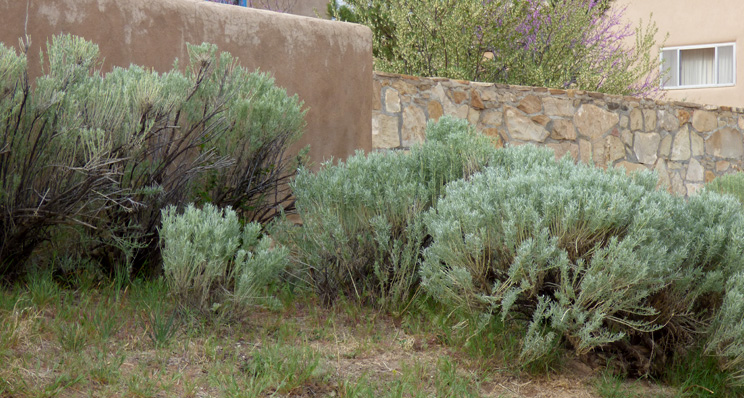
First on the list in April was pruning the chamisa (or rabbitbrush). Each of the dozens of tall shrubs needed attention, and I took it slowly, my aching arms reluctant to remember what physical labor felt like. But after some weeks my shoulders were toned and the rows of chamisa stood neatly.

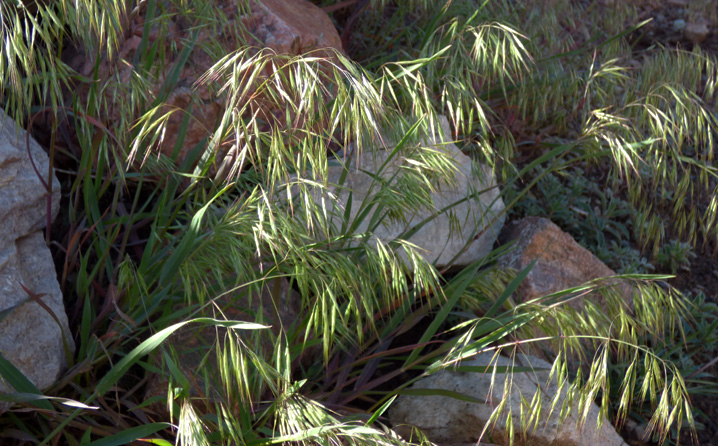
chamisa prunedAs the sun rose each morning, I would wander into the yard with a cup of tea and bend to the ground, hunting cheatgrass. I pulled cheatgrass by the stem, I pulled it by the handful. For two weeks straight I stuffed our 96-gallon trash can to the brim with cheatgrass stems alone. In shady corners it grew tall and lush, but on dry sunny slopes it could set seed from a stem only an inch or so high. My respect for cheatgrass grew, along with calluses on my knees.

cheatgrass among rocksBetween pruning and weeding, I tested the drip irrigation system ringing the property, digging up every line and replacing clogged parts. Did I mention an aching back? I’m ten years older than when I last crawled around a yard!

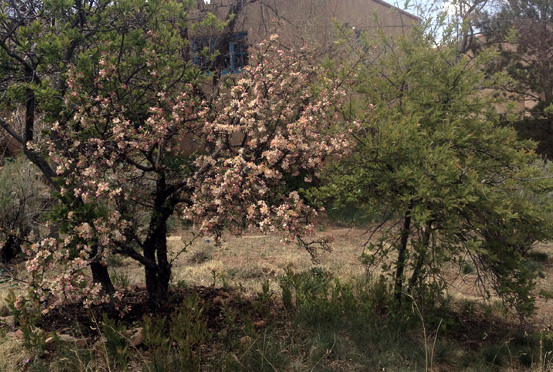
Through blustery days and warm scented afternoons, I pruned and weeded and dug. In April, bundled in long johns and layers, I was surprised to feel toasty and content even in strong winds and 48 degrees, as long as the sun shone. I let the peace of the dirt seep in. I followed the currents of birds and thrilled to the humming of bees hard at work in flowering trees. Gardening was good, I discovered, for the inner transformation I’ve been going through; living outdoors among the swirling nature helped me integrate.

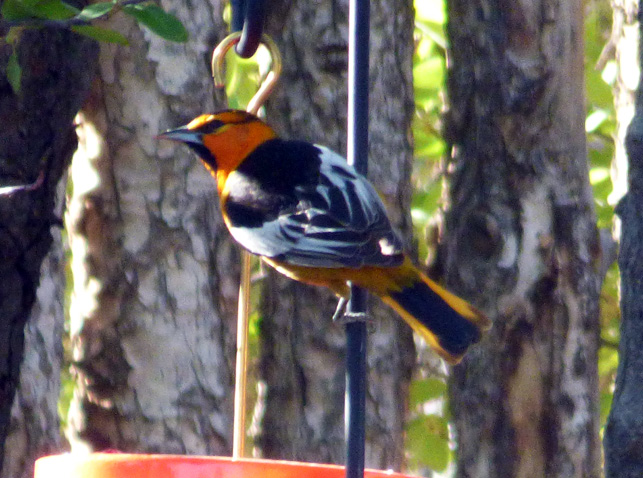
crabappleWhen I wasn’t gardening, I stalked birds in the yard with my new zoom lens. Bullock’s orioles are wary, and this male was so far away that he still came out fuzzy. New quest: a good oriole photo.

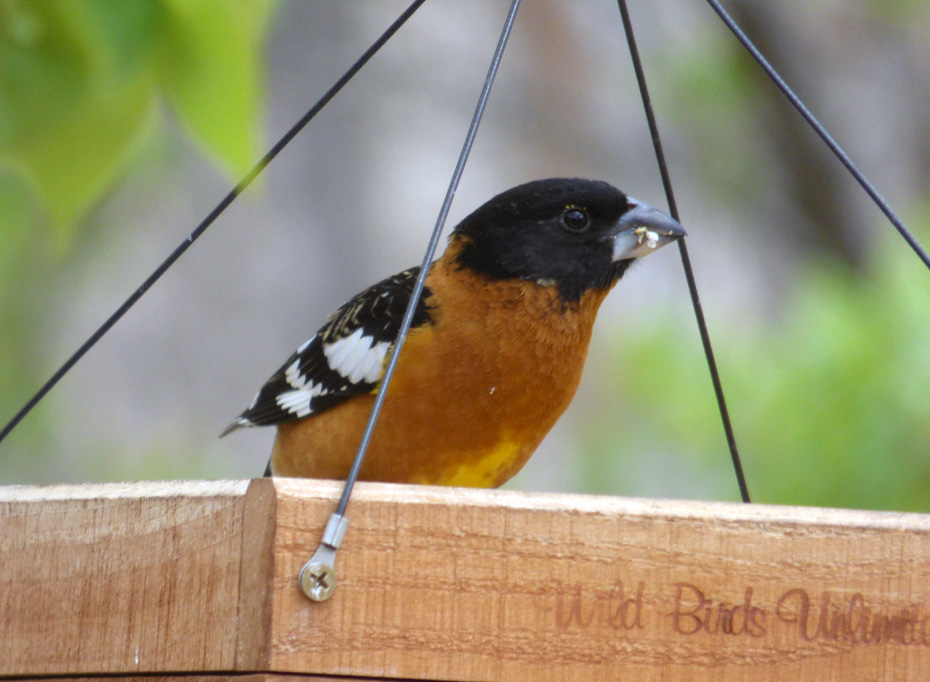
oriole at feederThis male black-headed grosbeak was more accommodating because I was hidden behind glass.

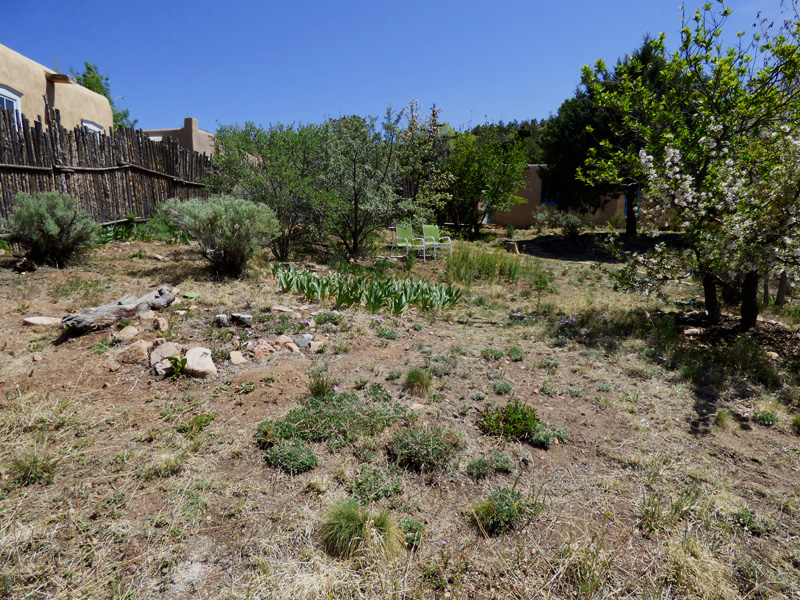
black-headed grosbeak at feederBy early May the yard was imperceptibly neater (imperceptible—after all those hours!) but still yellow-brown. After four years of drought, including a dry winter and spring, the land could not yet turn green.

yellow-brown yardI couldn’t wait to get busy sowing grasses and wildflowers. But at my favorite native plants store they told me that unless the ground had warmed up to 60 degrees the seeds would just sit there and not germinate.

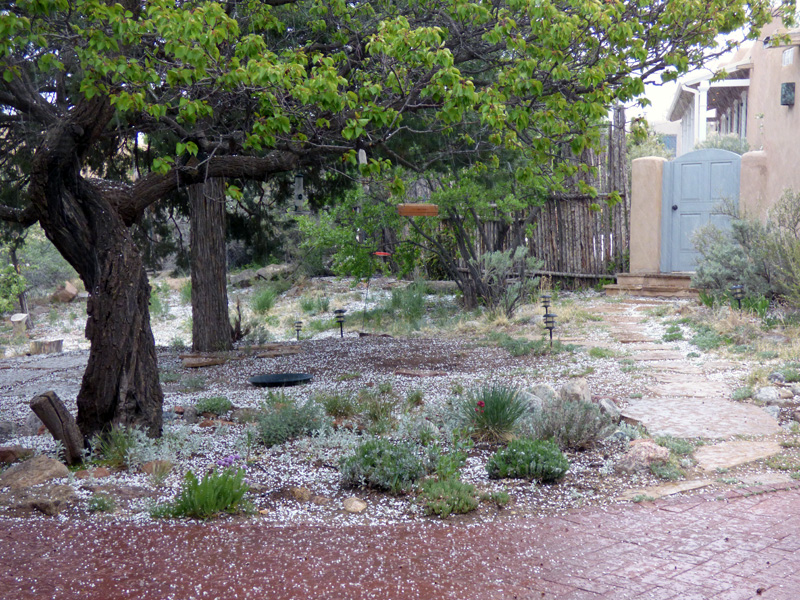
In mid-May we were enjoying balmy days in the high 70s, and I was chomping at the bit. But spring in Santa Fe is fickle, and at the end of one warm week we got a day of hail-sleet-snow and at the end of the next, on May 15, a killing frost.

snow-sleet-hail in MayTime to wait some more. I took the opportunity to purge two weedy plants from the yard: mustard (it’s invasive) . . .

mustard in yardand stickseed (its prickly burrs hurt bare toes and demolish socks).

stickseedAt some point it dawned on me that I was doing restoration work. I’d helped to restore riparian corridors in Oakland and wildflower meadows in Boulder. Now I was managing my own high prairie restoration project in the Transition Zone of Santa Fe!

Jubilation was tempered by the the other realization that dawned about the same time: 12,000 square feet is a lot of space. This was a bigger job—and responsibility—than I’d expected. Anxious questions began to arise: How would I know when to plant? How much to plant? Was there any leeway for errors?

Finally the ground warmed up once more. I set hoses and sprinklers in place (no simple job to cover all from two faucets!). Was it time?

I followed the weather reports. Rain was predicted for the end of the week.

By Thursday afternoon all was in place. I checked the sky. The clouds were growing black. It was time to plant.

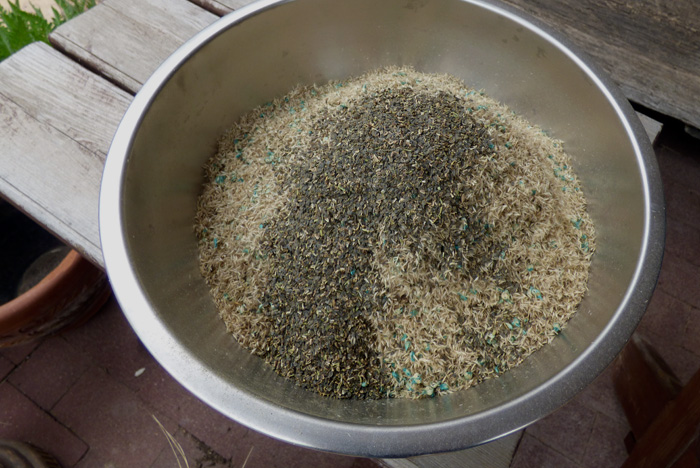
rain comingI opened bags of seeds and stirred them into a bowl: a mix of native blue grama and buffalograss plus wildflowers such as yellow coneflower, Mexican hat, blanketflower, and blue flax.

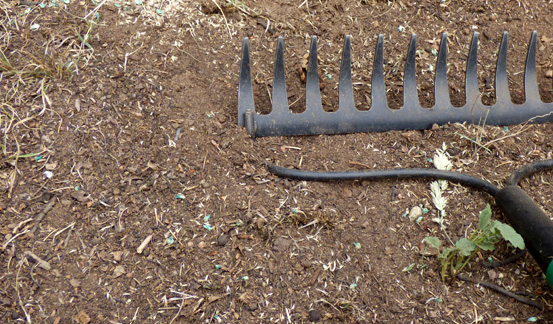
seeds from native plantsI sprinkled seeds onto the ground and lightly raked them in, not because these native seeds needed to be covered—they didn’t—but to hide them with the thinnest layer of dirt so that, as they told me at the nursery, “the birds don’t see dinner and the ants don’t carry them off.”

rake and seeds

Halfway through the planting the wind kicked up and threatened to carry off my precious cargo. I clutched the bowl to my chest, protecting its light-as-air contents, then enlisted Tim to follow right behind me with the rake.

The gusty winds foretold rain, but here in the desert I’ve already learned not to believe the wind. It may blow strong, and rain may fall from the clouds, parading across the sky, only to evaporate thousands of feet above the ground, never dampening the earth. So despite gusty winds, I set the sprinklers and gave the seeds their first bath.

At 3:00 the next morning I woke to lightning and thunder, then a sound I hadn’t yet heard in Santa Fe—rain pounding on a roof. I crept out of bed to a dark window.

Torrents of water! This drought-stricken land was finally getting relief.

The next morning dawned bright and sparkly fresh—for a few hours. What a gift, to see wet dirt where yesterday it had been bone dry! More heavy showers fell that afternoon, flooding city streets, then more rain on Saturday and Sunday as well—a dark and wet Memorial Day weekend.

The locals were delighted. Something in us relaxed as we felt the earth around us stretch and plump, freshening with new life. People greeted one another laughing. “Isn’t this rain wonderful?”

In between showers I wandered the yard, checking seeds. The rain had uncovered many but not washed them away. After two days of rain they began to stretch, their old jackets suddenly too small.

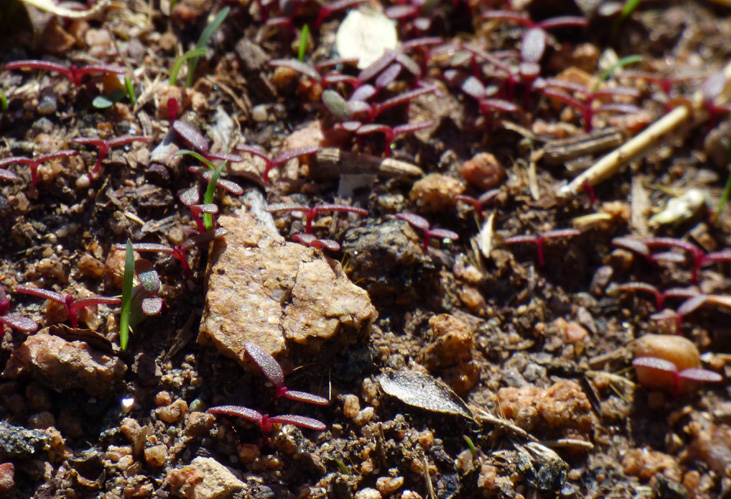
seeds after rainEach day for a week I checked the ground, waiting and watering. Finally I glimpsed the first evidence—thousands of minuscule shoots. I didn’t expect grass to be red!

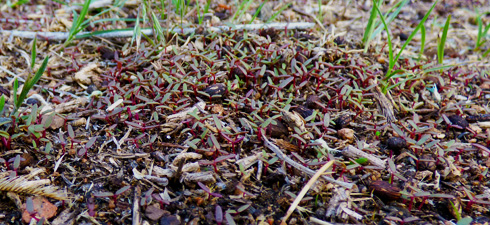
seeds sproutingseeds sprouting 2It’s been a week and a half since the seeds landed in dirt and were watered by glorious rains. Their tiny shoots are now weaving a gossamer green film across bare earth.

seeds todayMore updates to come!

Posted in nature | Tagged , , , , , , , | Comments Off on Farmer in the yard

The underworld is alive!

Sandra Steingraber spoke this week in Santa Fe, and as usual her words were disturbing and rousing at once. I’ve admired Sandra for years—her decades-long work as an Earth-advocate, first researching and writing about the public health dangers of everyday toxic chemicals and more recently working to end the insanity of fracking. This week she urged us to see these two huge issues as two trunks of a single “tree of crisis,” a tree with its roots in fossil fuels. “Our ruinous dependence on fossil fuels,” she said, underlies both of these Earth-killing crises.

Steingraber is a biologist, and she spent an early part of her talk outlining the mechanics of climate change because, as she explained, in one survey 350 well-educated people were asked to describe the process, and “exactly no one got it right.”

But where Sandra’s talk really came alive for me was when she described the ecosystem of shale, the deep rock a mile underground where fracking is done. The shale is full of methane bubbles, which are actually, she explained, the fossilized bodies of the billions of sea creatures—the only form of life at the time—who died hundreds of millions of years ago.

These little, effervescent methane bubbles—what we are in such a hurry to extract—are the decomposed bodies of sea lilies and squid. They didn’t decompose as ours do because the chemistry of the Earth was different at the time. They decomposed as bubbles of methane buried in shale.

And methane, of course, is natural gas.

So the beds of shale where fracking is done are actually vast burial grounds, cemeteries, holding the bodies of billions of sea creatures. When you turn the the gas on at your stove, you’re actually using the decomposed bodies of these creatures.

And then she got really excited as she introduced us to organisms that many of us had never heard of: the archaea, a third domain of life (in addition to bacteria and eukaryota—plants, fungi, and animals). My generation never learned about archaea in school because they hadn’t been discovered yet, and they weren’t classified as a separate branch of life until the late 1970s, when I was in college.

First found in extreme environments, like Yellowstone’s hot springs, archaea are now recognized as living everywhere, including in people’s belly buttons. They are one-celled creatures, like bacteria, but their chemistry is different, and many still love the weird chemistry of Earth’s environments 400 million years ago, when archaea evolved, when the oceans were hotter and there was less oxygen, which is why many of them thrive in what we think of as inhospitable conditions.

And that’s where they connect up with the ruinous practice of fracking. Some archaea live deep underground, a mile below the surface of the Earth, where fracking is done. Steingraber said,

The underworld is alive, and I don’t mean in a mystical, Gaia-is-alive kind of way. I mean literally alive. Metabolically alive. With these one-celled creatures.

Archaea are so alive, in fact, that they have figured out ways to move electrons around and alter their environments. The archaea living a mile below the surface lack means to transfer electrons themselves, so they use rock. Steingraber the biologist got all animated at this one:

They send electrons into rock to alter their environments. They send nanowires into rock! They make grids of nanowires. They make complex colonies!

The ooohs and aaahs of the audience underscored our shared amazement. We’d never heard of these creatures. And yet somehow we immediately sensed the larger truth: we’ve been carrying around the wrong metaphor of the underworld. Not a shadowy place of the dead, the deep strata of Earth are very much alive—with colonies of one-celled creatures.

Those living communities of very active creatures deep underground like to wreak havoc with drilling and extraction. (Good on them!) Archaea are so alive and prolific that they tend to clog the pipes and stop the flow of methane. (Smart archaea!) This is why uber-toxic chemicals are added to the fracking fluids—to kill off the communities of microbes and keep the methane flowing. These superconcentrated pesticides are the toxins that can percolate into groundwater when cement casings crack and fail. As Steingraber reminded us,

Because we now know that 5 percent of drill casings fail from the start, and the failure rate continues to increase as the cement casings age, shrink, and crack.

Out of Sandra’s disturbing, discomfiting talk, I took this one piece of joy: the living cacophony of Earth extends far below the surface and is far stranger and more wonderful than we have imagined. Steingraber said,

What we need to take away is that the surface ecosystem extends a lot further underground than we thought. We were wrong about the underworld. It’s very much alive.

________

For more information:

Sandra Steingraber’s website gives information about her books, including her recent Raising Elijah, calling for heroic actions to match the severity of our current ecological crisis.

“Coffee in Jail” from Orion is one of my favorite essays, about landing in the county jail for civil disobedience against fracking and how she discovered a piece of writing in her cell that she didn’t expect.

Posted in nature | Tagged , , , , , , , , , | 1 Comment

What’s the end of this story?

I am not a collapsitarian. Yes, I firmly believe that industrial civilization has pointed its collective GPS straight toward the cliff. But I don’t write about collapse, and I don’t often talk about it. Why not? Because focusing on collapse tends to convince people there is only one ending to the story. It’s an arrogant and hope-sucking conviction—and it is simply false. We do not yet know the end of this story.

So when the Guardian announced this month that industrial civilization could collapse in coming decades, I sucked in my breath. And when it said that its story was based on a study about to appear in the peer-reviewed journal Ecological Economics, a study that was funded in part by the Goddard Space Flight Center of NASA, I knew that fringe headlines had just gone mainstream.

The authors of the study compared human-nature interactions in certain advanced, complex civilizations in the past, such as Roman and Mayan, with those in modern industrial society. They conclude that under conditions similar to today’s,

we find that collapse is difficult to avoid.

The week this study was publicized was the same week, as it happens, that the American Association for the Advancement of Science (AAAS), the largest scientific society in the world and a notoriously staid group, issued a bold call to action. “What We Know” is a clear, calm document with some blunt facts about climate change. Point 2:

We are at risk of pushing our climate system toward abrupt, unpredictable, and potentially irreversible changes with highly damaging impacts.

Two warnings of collapse in the same week: serious changes lie ahead.

I find the warnings oddly cheering. I feel less crazy than I did a few years back, when the evidence for collapse was just as strong but we had our collective head buried in the sand about climate change. What people are feeling and what they are saying no longer belong to separate universes. We are being more truthful, or at least beginning to be.

I do have some serious questions about the NASA-funded study. Comparing modern society to Roman or Mayan is fraught with problems, one of which is that we don’t actually know what “collapse” in those societies looked like. The “fall of Rome,” for example, may have had little impact on the shape of everyday life for most people. (You can read more about this in chapter 12 of Kissed by a Fox, which I based in part on the work of historian Peter Heather.) Did “collapse” mean that people spread out away from what had been cities, as some Mayan scholars think? If so, it suggests there was someplace to go—very unlike the situation we face today.

But about the AAAS document I have no questions. Its three points bear repeating:

  1. Climate change is real, it’s caused by us, and 97% of scientists agree.
  2. We may be changing nature irreversibly.
  3. There is much we can do.

I want to focus on number 3: There is much we can do. On this point both studies completely agree. Societal collapse, while difficult to avoid, is not inevitable.

We could reset the GPS by choosing differently.

Right now.

The NASA-funded study offers two excellent recommendations:

Collapse can be avoided and population can reach equilibrium if the per capita rate of depletion of nature is reduced to a sustainable level, and if resources are distributed in a reasonably equitable fashion.

In other words, use fewer resources per person, and distribute resources more equally.

The AAAS document is even more blunt:

The sooner we make a concerted effort to curtail the burning of fossil fuels as our primary energy source and releasing the CO2 to the air, the lower our risk and cost will be.

These are straightforward assignments. The job ahead seems clear:

  1. Cut down on consumption. Stop burning fossil fuels.
  2. Work toward greater social and economic equality.

Each one of these is a monumental task. But people change, and even societies can change on a dime. When I was a child all restaurants and offices were blue with smoke. Smoking was entrenched by centuries-long habits and big money. Few could predict that in forty years most environments would be smoke free.

At this moment, we need the biggest change that has ever happened, because the stakes are higher than human beings have ever faced.

Will we challenge laws that stimulate endless growth? Will we wake up to our interrelatedness with all other creatures? Will we insist on solar power? Will we begin to reward reciprocity instead of profit? Will we design interactions based on respecting nature more than using nature? Will we pass rights-of-nature laws to guarantee healthy eco-communities for the children now being born?

I don’t know. But I do know that every one of these is possible.

And even if we did all this, would we avert the cliff? This too I don’t know. And neither does anyone else, because the end of this story is not yet written.

How do we live in a time of eco-crisis? I take heart from the wisdom of Buddhist teacher and writer Joanna Macy. A few months ago she said:

Yes, it looks bleak. But you are still alive now. You are alive with all the others, in this present moment. And because the truth is speaking in the work, it unlocks the heart.

We need our collective heart. Which means the heart of each person. You. Me. Everybody. Whatever we do that brings us back to the heart will help. Every little thing we do to increase respect and equality and happiness—to bring that little spark of warmth and aliveness back into people’s eyes—will help. Because the more of that warm spark, the less stuff people need and the more love they show each other.

And whether or not we avert the cliff, we will have a much better time getting from here to there, and if we can increase the work of the heart, the “there” we arrive at will be much kinder and more livable for everyone.

Even—and perhaps especially—in a time of eco-crisis, we can answer the summons. Macy continued:

It’s like a trumpet call to a great adventure. In all great adventures there comes a time when the little band of heroes feels totally outnumbered and bleak, like Frodo in Lord of the Rings or Pilgrim in Pilgrim’s Progress. You learn to say “It looks bleak. Big deal, it looks bleak.”

And you do it anyway—for the adventure is not yet finished, and astounding challenges can call forth astounding creativity.

This is a time for big risks and big changes. This is a time to pull out all the stops. This is a time to stand up and be counted in our collective story. Because each of us is a character, each an actor in this story.

What’s the end of this story?

Come on, let’s find out.

Update: For excellent critiques of the NASA-funded study, see this article by Ian Angus at Climate & Capitalism, posted March 31. The author of the Guardian report defends here his claim that the study was partially funded by NASA.

Posted in nature, politics, spirituality | Tagged , , , , , , , , | 12 Comments