
Can we imagine a better future? On dystopias and hope

A blog reader named Ray contacted me a while back to say that he shares a deep concern about climate change. In fact, he’s publishing a novel about it on his website. In his book the Arctic polar ice cap melts quickly (as we can already see) and causes more abrupt global warming than we expect. The rapid climate change leads to a collapse in agriculture, there is a surge of terrorism, and right-wing extremists stage a coup against the US government.

He was curious what I might think about his book.

I had to confess my discontent. I don’t enjoy dystopian novels. And that’s putting it mildly. I usually don’t subject myself to them. These days, they’re getting hard to avoid, since dystopian visions always surge in popularity during a time of crisis. People sense that the world as they know it is dying, and they are frightened beyond belief—and I mean this quite literally. Climate-change denial of the extent that we have witnessed in recent years has to be fueled in part by a fear so big there is no name for it. And writers of dystopian novels are rising to the challenge, trying to portray our worst fears, to place them directly in our line of vision.

But here’s why I don’t enjoy dystopian stories. They tend to be well acquainted with horror. They often parade cruelty, showing people acting toward one another and other beings in the worst possible ways. And they may be celebrated as “manly” or “courageous,” as if staring at the worst possible version of ourselves takes a special kind of bravery. I understand the fascination with horror. I get the value of experimenting with doom and gloom. I just don’t need to hang out there.

And furthermore, as I told Ray, instead of being too hard, dystopia is too easy. Given our bedrock belief about human nature—that it is warped toward selfishness, greed, and cruelty—we find it easy to imagine ourselves acting badly. It is a whole lot harder to imagine a future where people behave with generosity and kindness, which may be why fewer stories explore these options. And why, when they do, they are labeled utopian, which means, literally, “no place,” an impossible ideal.

So I emailed Ray:

We tend to expect the worst of ourselves—one of the main themes in my book, and a pessimistic cultural attitude that I try to demystify by showing some of the history of it. But stories of coping and courage and resiliency? They seem harder to imagine.

Why show the worst in people instead of the best? I asked.

Ray responded with the excellent point that stories showing the best in people tend to conform to the hero storyline (quoting with his permission):

Tales of heroes saving the day tend to counsel complacency—somebody else, some extraordinary being, will take care of it. These tales say, (1) there, there, it’ll be all right or (2) if you’re not extraordinary, don’t bother. Dystopian fiction says, we can’t let this happen.

Point well taken. Dystopian visions can be wake-up calls—this is the road we’re on, and we’ll come to a nasty end if we don’t change course.

But I have to repeat: dystopia is not hard to imagine. With our assumptions about ourselves, tales of cruelty and deprivation and chaos are easy to dream up (if not easy to craft; they take a storyteller’s skill as much as any other kind of fiction). They are easy to imagine because we are more likely to be surprised when people are generous or kind than when they are not. I spent a good share of my new book exploring why this is true and showing how mistrusting our own human nature goes along with a jaundiced view of the rest of nature as well.

Our cynical view of ourselves no doubt contributes to a lack of imagination for addressing the climate crisis. Bogged down by pessimism, we find creative solutions immeasurably hard to fathom—in spite of the fact that we already have the technology and the know-how. We seem unable to imagine people working smoothly together over time to restructure their lives and communities, to dream up new ways of living.

And so we fall back, as Ray suggested, on the hero’s tale, where one or two or three resourceful people outwit, outplay, and outshoot the opposition. It’s as if our imaginations can handle only a few people at a time being brave or resourceful or wise.

Writer David Sobel points out in the current issue of Orion magazine that dystopian fiction rules in teen culture. He finds a great deal of hope in it, especially when, as in The Hunger Games, young people act heroically, challenging the status quo. He lauds the genre precisely for celebrating teen heroines and heroes because in a culture like ours, where adolescents do not undergo formal initiation rituals, they need to be able to picture themselves in the big roles, tackling the big problems and changing the world for the better. He writes,

If we want to avoid the environmental catastrophes and repressive central governments pictured in current dystopian fiction, we’re going to need more adolescents willing to be heroic. . . . If Katniss and these other heroines compel us to be heroic, then perhaps these books are part of the solution.

He may be right. But we need a new storyline as well—something beyond the tale of the isolated heroine or hero.

We need a new storyline about us. All of us. About how we can work together. About how we can share—because sharing is common, not rare, in nature. About the empathy embedded in our DNA as deeply as the greed.

It will take nothing less than a new story of nature. And for this we need big imaginations, bigger than we’ve exercised so far. Big enough to imagine solving the climate crisis, not just suffering from it. Because only with imaginations that spacious will we have the energy and courage to tackle the problem itself.

Can we imagine a better future? For a change? Literally.

Posted in nature, writing | Tagged , , , , , | 4 Comments

Colorado Gives–today!

Today is Colorado Gives Day, when your giving dollars go farther. Over a thousand nonprofits are participating, which means your faves are likely listed at ColoradoGives.org.

If you don’t have faves, let me suggest a few:

Friend of this blog Dave Sutherland is on a personal mission to raise money for Colorado Alliance for Environmental Education (CAEE). He’s on the board, and he’s set a goal of raising $500 for CAEE. Visit his personal fund-raising page, and donate!

CAEE says,

Only 1-2% of Americans are environmentally literate and have the knowledge and skills to make informed decisions about the environment.

Teaching kids how nature works may be the only kind of education that makes sense in a world of humanly caused environmental crises. Help Dave meet his goal of raising $500!

High Country News offers consistent, high-quality reporting on environmental and social issues happening in the American West. It’s one of my favorite papers, and one of the very few I read regularly. It’s a nonprofit organization, and to keep offering its excellent journalism, it needs the help of readers everywhere who care about the West. Donate today to High Country News.

And if you’re reading this, even if you’re unemployed or broke, you likely know where your next meal is coming from. Many people in Boulder and Broomfield Counties don’t. Give today to Community Food Share, always doing awesome work to make food available to people who don’t have enough of it. The organization’s goal is nothing less than ending local hunger.

If you don’t live in Colorado, feel free to give in your local area. Or do good for the environment by doing good for people affected by Hurricane Sandy. The Solar Sandy Project provides temporary electricity to communities that are rebuilding by hooking them up to solar generators. Or donate to Occupy Sandy, which is organizing relief efforts in damaged communities.

These are just a few of the places where you can share what you have with good causes that need it. Give with an open heart. That way everybody benefits.


Posted in education, nature | Tagged , , , | Comments Off on Colorado Gives–today!

Solar for the 75%

On Sunday evening Bill McKibben’s Do the Math tour comes to Boulder to build the movement for weaning ourselves off fossil fuels—and fast. Sold-out crowds are greeting McKibben everywhere, and Boulder will be no exception. Appearing with McKibben is Josh Fox, creator of the film Gasland.

But if you didn’t snag tickets, you can still show your support for leaving fossil fuels in the ground—the only safe place for them if we wish to hand a livable world to our children. Come on Sunday afternoon to a free celebration at Unity Church of Boulder featuring Josh Fox, live music, a silent auction, and more, where you can join with others in “Jamming for a Frack-Free Colorado.”

Though people may think that decreasing fossil fuel use is a utopian, out-of-reach ideal, nothing could be further from the truth. The technology exists to vastly increase our solar power use. We lag behind certain other countries in creation and use of photovoltaic and other solar energy systems. The jobs created in building a solar infrastructure would be welcome in this economy. The amount of long-term and irreversible damage to the atmosphere and ecosystem saved by abandoning fossil fuel extraction would be enormous. The only thing lacking is commitment.

And information. Because most of us know so little about solar options, I’m going to feature solar energy in upcoming posts. This first piece is by my friend Rosana Francescato, whom I got to know a long time ago when we were both copy editors. Rosana volunteers for a Bay Area nonprofit, GRID Alternatives, in their annual summer Solarthon, installing solar panels on the homes of low-income people. As she says in her fund-raising video, “Just one typical GRID installation prevents 95 tons of greenhouse gas emissions. That’s like planting 272 trees!”

Rosana also called my attention to a new law making possible community solar projects here in Colorado (and she’s working for a similar law in California). Through subscribing to a solar garden, people who don’t own their homes can still enjoy the planet-saving and cost-saving benefits of going solar. The Colorado law went into effect earlier this year, and the first community solar projects are under way.

Here is Rosana on solar for hard-to-reach roofs. Did you know all this was happening in solar energy? I didn’t!

SOLAR FOR THE 75%

by Rosana Francescato

By definition, most of us are in the 99%. Some of us may even be in that mythical 47%. But there’s another group that many of us are in, without even being aware of it: the 75%. That’s the estimated number of people who can’t get solar on their roof.

While leases are helping far more people go solar than before, 75% of us are still left out of the equation. We may have shaded roofs, rent our homes, or live in multi-unit buildings. And these are just a few of the reasons preventing so many of us from going solar.

But don’t despair! There’s hope for the 75%, and plenty of it. The boom happening right now in community solar is making it possible for almost anyone to benefit from solar power. At a recent Community Solar Forum put on by Solar Sonoma County, the 75% became a theme as we learned about some of the options:

  • Community Choice Energy: Programs like Sonoma Clean Power and CleanPowerSF are enabling utility customers in some areas to buy their power from renewable sources.
  • Solar Gardens: Some states have laws that allow virtual net metering, which lets utility customers subscribe to solar power from an installation not on their own roof. [Colorado readers: that’s us! The new law went into effect this year.]
  • CLEAN programs, or feed-in tariffs: By promoting these programs, the Clean Coalition is working toward the goal for 2020 of 80% of all new electricity generation in the United States coming from renewable energy sources.
  • Co-ops: Energy co-ops like the San Francisco Energy Cooperative allow anyone to participate in solar for as little as $50. They hope to be a model for other co-ops around the country.

The speakers at the forum all had slightly different perspectives, and they were focused on different ways to bring solar to communities. But they all shared the goal of helping as many people as possible to participate in renewable energy—that is, reaching the 75%.

JoyHughesCommunitySolarForum

Joy Hughes explains solar gardens to an audience of 60 attendees at the Community Solar Forum

All of these ways to bring solar to the 75% are important and highly effective — and even affordable. Models like community choice energy,  solar gardens, and CLEAN programs generally result in savings, especially over time. They bring a slew of other benefits, like cleaner air, local jobs, increased national security. So it’s crucial to support these efforts. Still, while a lot is happening already, some of these programs can take years to implement, and they aren’t yet available everywhere.

In the meantime, how do we get the word out to the 75% that there are options for them—for us—now?

For most people, that will mean an appeal to their pocketbook. Those with an active interest in supporting solar for altruistic reasons are a minority. But most people like the idea of saving money or getting a good return on an investment. If they can do good at the same time, that’s a nice benefit.

And now there are more ways to invest in solar and do well while doing good. Energy co-ops can already provide a return on small investments, and the JOBS Act should allow for larger investments in the near future. Other organizations use crowdfunding models where people can move from recouping their investment to receiving a return on that investment. For example, Mosaic allows people to invest in solar projects and get paid back from the clean energy produced.

There’s more coming, so stay tuned! Before long, we’ll have solar for the 75%. To learn more about community solar, check out the following:

This post was originally published at Mosaic on 11/12/12.


Posted in nature | Tagged , , , , , , , | Comments Off on Solar for the 75%

The law of the ground is sharing

What does Thanksgiving have to do with an election? This year, a whole lot. The start of the season of sharing follows close on the heels of a season full of not-so-generous attitudes.

I’m thinking of Mitt Romney’s sour note that the election was bought by giving “extraordinary financial gifts” to some voters. “The giving away free stuff is a hard thing to compete with,” he told his well-off donors to excuse his loss. His words were echoed by extreme-right pundits who nearly wept over a nation of “takers,” a country that “is interested in handouts.”

I don’t know what country they live in, but it’s not the one I know.

In my country, people with few resources give gladly of their time and energy. More than 26 percent of people volunteer their time for nonprofits, which amounts to 65 million people nationwide, including people from all the groups of “takers” on Romney’s list: African American, Hispanic, Latino, young, female. They do everything from teaching literacy to feeding orphaned baby birds to preparing meals for the elderly.

The complaints about a country of takers are so out of square with reality that I can only think that the words arise out of deep-seated fear. Does the language of takers appear when privileged people become frightened of sharing?

For my new book I did a lot of research on sustainable societies—cultures that live in balance with their surroundings, not taking from the land faster than it can replenish. The common element in all such societies is that they place a high value on sharing. Different groups structure their sharing in different ways. For Aboriginal peoples in Australia, sharing means giving of their land’s resources to any visitors who ask. The obligation is not just a nice sentiment. It’s not just being good. Aboriginal people believe that nature mandates sharing. It’s built into the law of the ground—and in this way is different from the laws of white people. From chapter 12 of Kissed by a Fox:

“Whitefellow law goes this way, that way, all the time changing,” said Doug Campbell, a senior Yarralin man. “Blackfellow Law different. It never changes. Blackfellow Law hard—like a stone, like that hill. The Law is in the ground.”

A very long time ago, Western societies began passing laws to reward the collecting of wealth with a bonus. That bonus was interest on debt. Charging interest came into use in the ancient Mediterranean empire of Sumeria around 3000 BCE. It helped make empires possible because it aided the collecting of money and resources into fewer and fewer hands. Charging interest was a hallmark of Greek and Roman societies, and it set those powers apart from many of their neighbors, some of whom, like the Jews, called charging interest the greatest possible sin because it split a community into haves and have-nots. Since the Roman era, societies that trace their history to the Mediterranean have rewarded ownership with a bonus of interest or rent.

In other words, we provide an incentive for accumulating more than sharing. In our fundamental system of laws, we enshrine the practice of gathering more than that of giving, the practice of holding over that of releasing.

Sustainable societies, by contrast, offer incentives for sharing. I think of potlatch societies, where people gain prestige by distributing their resources. More lavish distributing results in more prestige. Ronald Trosper is an enrolled member of the Flathead Reservation and a Harvard-trained economist who argues that the potlatch system among coastal peoples of northwest North America ensured an abundant supply of salmon for two thousand years, and he offers mathematical models to show why. A house headed by a chief would accumulate wealth for a number of years, then host a feast and giveaway to celebrate a special occasion such as a marriage or birth. The house provided all the food for the feast as well as gifts for every guest. From Kissed by a Fox:

Because the feasts were public affairs and all the gifts were publicly counted and announced, it soon became obvious if a particular house was not doing a good job of being generous. To keep their positions, chiefs had to meet the communal standard of generosity. And in order to have enough surplus to share lavishly, they had to take scrupulous care of their food territories. Each house was obligated to the salmon to consume the salmon’s gifts sparingly and share the salmon’s gifts generously, or the salmon would fail to return in the future. The society, in other words, set up incentives for generosity rather than selfishness.

People made environmentally appropriate choices because their status depended on sharing. If they depleted the salmon, they would have nothing to share. Failure to share meant a fast trip down the social ladder.

What many indigenous cultures have long known is that resources always flow in two directions—away from as well as toward. For a society to be sustainable, goods must be distributed after they are accumulated. The only sustainable equation is one where gathering and giving balance each other, an equal sign resting between them. Any society that offers incentives for gathering, such as ours, will need equal incentives for giving because dispersal is the other half of the cycle of life. From Kissed by a Fox:

I stand next to a cliff overlooking the ocean. The day is sparkling, warmth radiating from nearby rocks though my jacket is zipped to the chin against a stiff and chilly breeze. A line of pelicans flows low across the water, only a wingbeat away from the waves, taking advantage of the cushion of air that bears them along just above the surface of the sea.

The sky is so blue it hurts. Darkly joyous waters crash again and again into black rocks just offshore. I set out walking along the shore into the wind. My shoes sink into the sand; plowing forward takes effort. Thoughts trail into reverie as I slip into the rhythm of left foot and right foot.

Every wave that flows also ebbs. The water that falls from the sky tumbles and percolates to the sea and is taken up again to sky. Molecules collect for a time into one form and then scatter, only to collect in a different form. Food becomes fertilizer and once again food. One species proliferates, only to be checked by the rise of another. Every striving in summer is followed by resting in winter, every daytime followed by night. Each gathering into birth also disperses into dying.

Taking breath in, giving it out. Left foot, right foot.

To be sustainable, gathering in needs to be balanced by giving. To live by the law of the ground, we have to share.

For more information:

  • About Aboriginal cultures, see the books of Australian anthropologist Deborah Bird Rose: Nourishing Terrains: Australian Aboriginal Views of Landscape and Wilderness (Canberra: Australian Heritage Commission, 1996) and Dingo Makes Us Human: Life and Land in an Australian Aboriginal Culture (Cambridge: Cambridge University Press, 1992).
  • On the potlatch system among northwest coastal tribes, and how it might be implemented among corporations today, see the Ecology and Society article by Ronald Trosper, also his book, Resilience, Reciprocity, and Ecological Economics: Northwest Coast Sustainability (London: Routledge, 2009).
  • About why sharing or redistribution makes good economic sense, watch this talk by Joshua Farley, an ecological economist at the University of Vermont.
  • For in-depth reflection on all these ideas, see the last chapter of Kissed by a Fox.
Posted in nature, politics, spirituality | Tagged , , , , , , , , , , , , , , , , , | 2 Comments

Big bluestem in a dry year

This week the climate data center NOAA released its “State of the Climate: Drought” report showing moisture conditions state by state for the past twelve months. Colorado, as expected after our super-early, dry spring, is in a long-term drought, as is much of the Southwest and southern plains.

But the native plants of the prairie knew what to do with this dry summer: hunker down for the long haul. How did they do it? Here is their strategy.

The patch of big bluestem near my house looked like this a couple of years ago, in October 2010:

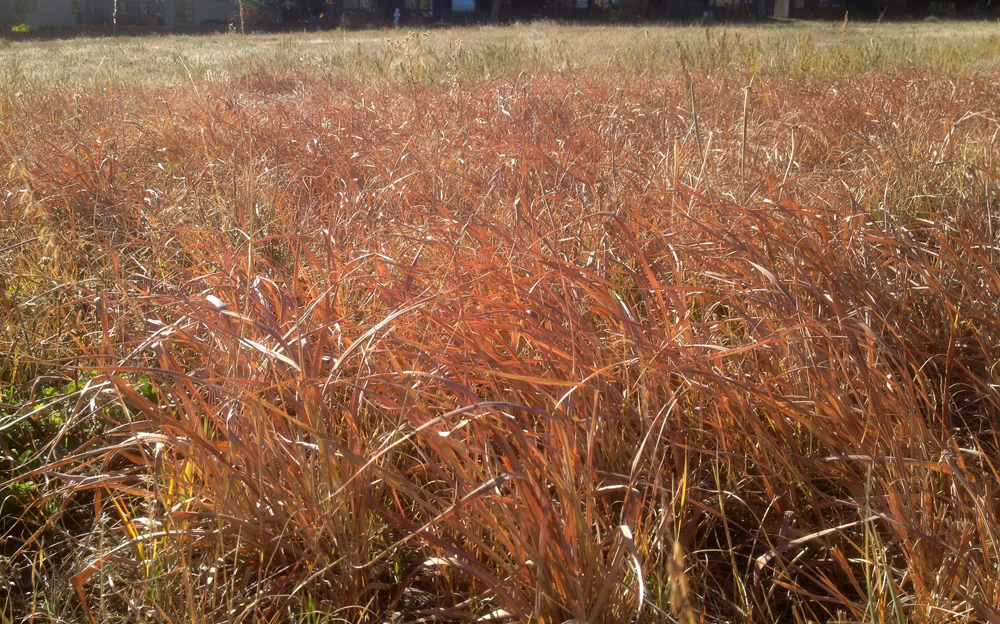
Now here is the same patch of big bluestem this year, in October 2012:

What’s missing this year? The tall stems ending in seed heads. Lacking moisture, big bluestem simply decided not to make seeds this summer.

Big bluestem can survive without making seeds because this grass is in it for the long haul. The plant has roots that travel down to forever—at least compared to the grasses we are used to seeing in our lawns and parks and golf courses.

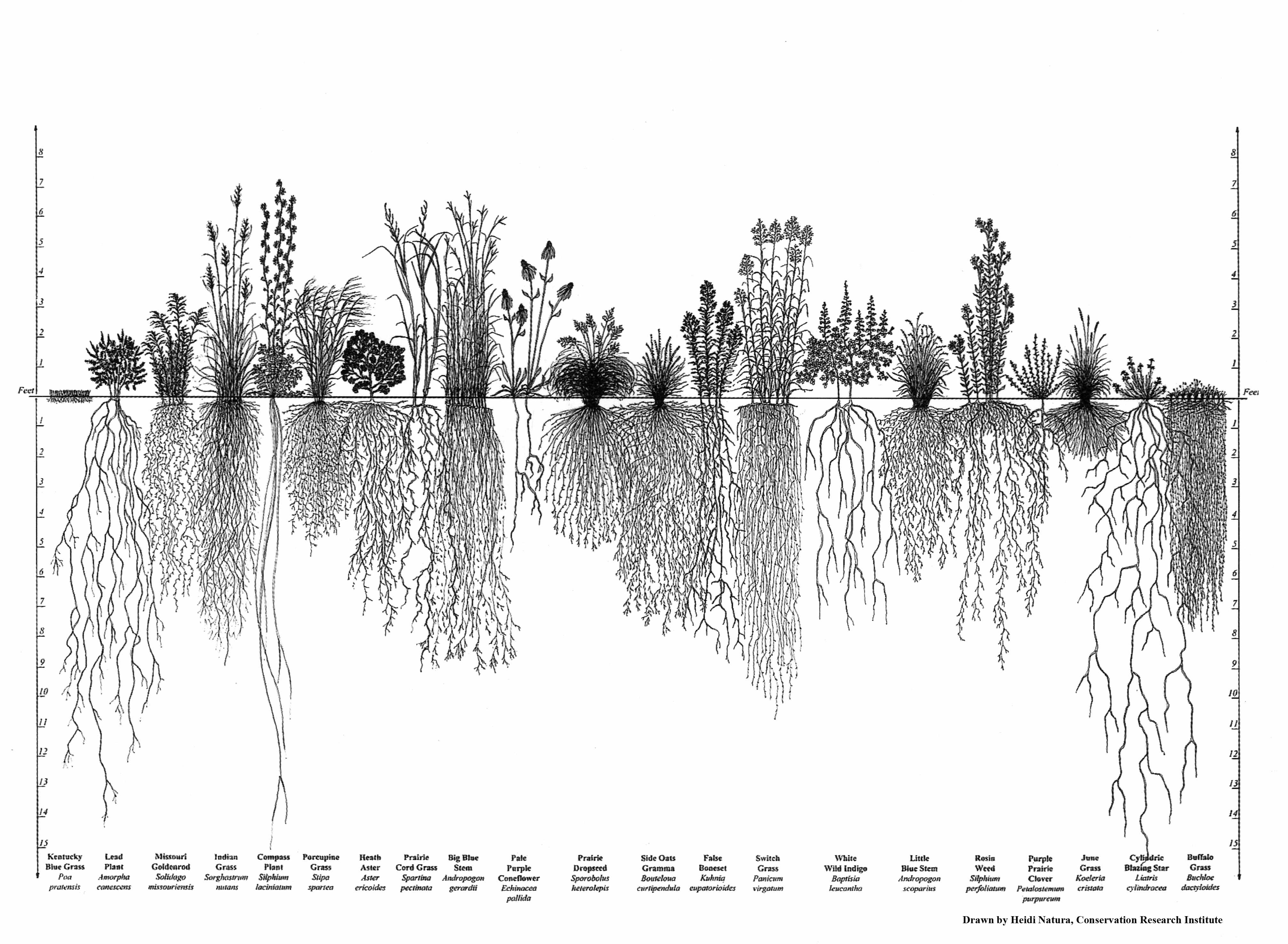
Just how long are big bluestem roots? Take a look at this marvelous illustration, which I found in a book that had nothing to do with prairies:

Drawn by Heidi Natura, Conservation Research Institute

There’s big bluestem, about a third of the way from the left. Its roots go down not one or two feet but nine feet into the soil. Nine feet! This is the grass that kept the prairie in place for millennia, the grass that was plowed up by European settlers in their frantic rush to plant short-rooted food crops. After the big bluestem and its long-rooted prairie-plant companions had been torn out, the prairie soil was opened to the wind, and the Dust Bowl ensued.

By contrast, look in the diagram at Kentucky bluegrass. This is lawn grass. Having trouble finding it? That’s because on the scale of the prairie, Kentucky blue barely exists. It’s the little toothbrush bristle at the far left with roots only a couple of inches long. Those tiny roots are no match for the strong winds that buffet the prairie plains, the arid conditions at the surface of the ground. To thrive in the windy, sun-baked, fire-seared plains of Colorado, you need deep, deep roots.

In an era of global warming, those long, long roots perform another service as well. Big bluestem has what plant ecologists call high root-to-shoot ratio, meaning that a lot of the plant is underground. And therefore it is especially adept at storing carbon.

I love big bluestem. Not just for its autumn colors, which are splendid, but also for its adaptability. If one year doesn’t work for you, hunker down and wait for the next. Rely on deep roots to carry you through. I love how strong it is, strong enough to hold precious soil in place for hundreds of thousands of years. I love that it could be a strong ally in the climate change we will continue to face.

We need native grasses—especially now. With the increasing likelihood of long-term drought on the high plains, we need the native plants, who know how to thrive in uncertain times. We need their hardiness, their ability to hold and build soil, their carbon storage, their ability to withstand fire.

Consider adding a patch of native grass to your garden or yard. I have seen small bunches of native tallgrass, like big bluestem, decorating the edges of flower beds or gardens. Enjoy the tawny, maroon hues that big bluestem wears in autumn. And take inspiration from its deep roots.

Posted in nature | Tagged , , , , , , , , , , , | 2 Comments