ForeWord Book of the Year Finalist

Kissed by a Fox is a finalist for the ForeWord Book of the Year book awards.I am happy to announce that Kissed by a Fox is a finalist for the ForeWord Book of the Year book awards in the Nature category! ForeWord Reviews celebrates quality books from independent and university presses, and it goes out quarterly to 7500 librarians and booksellers. Judges picked the finalists from over 1300 books entered in 62 different categories, and winners will be announced at the American Library Association (ALA) annual conference in Chicago on June 28.

To peruse the list of eight finalists in the Nature category, go here.

Last year’s first-place winner in Nature was The Ramble in Central Park, a book of photographs of the strip of woods and water that keeps New Yorkers sane. During my trip to New York last month I didn’t have time to explore Central Park, but I heard a New Yorker say, “In other parts of the country people go out to enjoy nature, but here in New York City, we need Central Park. I mean, we need it.”

Another finalist from last year deserves a special shout-out: Tom Fleischner, my colleague at Prescott College. Tom earned Honorable Mention in the Nature category with his book, The Way of Natural History. I’m proud to see two Prescott faculty on the ForeWord list of book awards finalists in two successive years.

So, be inspired! Read and enjoy a good nature book.

More info on Kissed by a Fox, including more reviews, here.

Posted in book, nature, writing | Tagged , , , | 2 Comments

A park in the sky

In each of the cities I visit for book readings, I try to take some time to connect with the more-than-human world. So last week in New York City I visited the High Line, New York’s beautiful park in the sky. Built on an abandoned elevated train track, the park is an oasis of nature in an urban area, a piece of biophilia planted in the heart of what used to be a gritty, industrial part of town.

Approaching the High Line park

Approaching the High Line

Up the stairs to the High Line park

Up the stairs to the High Line

Up above, a walkway stretches for blocks, lined with native grasses and plants.

The High Line park in February

The plants were apparently chosen to pay homage to the wildflowers that had sprouted on the rail line after it closed down in 1980.

Wildflowers on the line, from Friends of the High Line park

Wildflowers on the line, from Friends of the High Line

The line served freight trains in the meatpacking district, and it was built above the city street in the 1930s because the train tracks had been such a death trap:

High Line in operation, from Friends of the High Line park

High Line in operation, from Friends of the High Line

Railroad tracks are still in place, with this cool feature added today:

Recliners ride the rails at High Line park

Recliners ride the rails at High Line park

Even on a gray day-before-a-blizzard in the dead of winter, spots of color are visible. Yellow crocuses are nearly bursting, and a red berry bush brightens the ground:

Crocuses & red berries in High Line park in February

Birch trees lend an architectural view:

High Line park bench and birch trees

Another fun feature is the amphitheater leading to a picture-window view of—wait for it—the New York street below:

ampitheater to street at end of High Line park

In a different block, you can catch a glimpse of the Empire State Building:

Empire State Building from the High Line park

The High Line has changed the economics of its neighborhood so that now, I hear, apartment listings within range are sure to mention “view of the High Line.”

After half an hour of strolling the length of the High Line in 38-degree weather, I am ready for a hot cup of tea. But here’s another one for the bucket list: come back to New York City when the High Line looks like this:

The High Line in spring, from Friends of the High Line park

The High Line in spring, from Friends of the High Line

Summer flowers, from Friends of the High Line

Summer flowers, from Friends of the High Line

Posted in nature | Tagged , , , , | 1 Comment

Oaks against the sky

What’s your favorite landscape? For me, the oak savannah ranks pretty high. I got to know this eco-community during the decades I lived in California, and a few days ago I had the briefest opportunity to say hello to it again at the Helen Putnam Regional Park just outside Petaluma in Sonoma County. In the waning sunlight of a winter late-afternoon, my friend and I headed to the nearest park to pick up some trails and enjoy the views.

  Oak savannah

The oak trees were massive. It’s hard to show just how enormous these old trees are.

Coast & valley oaks

We saw two kinds of oaks. If you look closely at the photo above, you can see both. In the foreground is the valley oak, Quercus lobata, a deciduous tree whose large leaves turn brown and drop in autumn. Just behind it is the coast live oak, Quercus agrifola, an evergreen keeping its small prickly leaves all year round.

Standing under a tree and gazing up, you can see only a maze of gnarly branches, an effect heightened by the shadows cast in late-afternoon sun:

Gnarly oak

The bark of the coast live oak is often flecked with lichen, and the side of the tree that has no lichen may well be covered by moss. Here is the lichen side:

Oak lichen bark

But my favorite tree of the afternoon was this valley oak silhouetted against the view. Look at the deep crevice in the trunk, the hole through which you can view the sky.

Bowing valley oak

Posted in nature | Tagged , , , , | 1 Comment

Whistling in the wind

I’m traveling with the book this week, giving talks and readings in Arizona. It’s been unusually cold here, and in Tucson I learned just how hard it is to warm up in a city not built for freezing weather. But the people couldn’t be warmer! It was my first visit to Tucson, and I fell in love with its vivid colors, its diversity, the funky shops, the big sky.

And of course the saguaros. I’d seen the giant cacti many times from a distance, but this time in saguaro country I got up close and personal. Driving out of Tucson, I took a detour through Saguaro National Park west of the city, past the Arizona-Sonora Desert Museum.

Saguaros in Saguaro National Park

The temperature was warming, and a stiff breeze blew across the desert floor. At a turnout I hopped out of my car and followed a short path to the closest enormous saguaro.

Saguaros whistle in the wind

Standing at its base, I stretched out my hand, carefully positioning two fingers between the close-set rows of spines, and touched the saguaro. It was swaying slightly in the wind, as trees do. I felt an enormous life-force, strong and old, standing firm.

But then I noticed something else—a whistling sound, a high-pitched “wheeeeeee” flowing above me, emanating from the saguaro. The sound of wind through thousands of spines. I’ve heard the rustle of cottonwood leaves, the whirring of wind in pines. But saguaros make a different sound. They whistle in the wind.

Time was short, so after only a few seconds of enjoying the whistling saguaro, I headed reluctantly back to my car. But I added an item to my bucket list: come back to Tucson in springtime—when I can stay a while and the saguaros are blooming.

Posted in nature | Tagged , , , | 1 Comment

12 ways to give back to the Earth

Looking for a different kind of holiday gift? How about giving back to the Earth? Simple tips for respect and reciprocity with Earth. Bonus: if practiced, they will give back too. Reprinted from Intentblog.com. 

We may be deeply aware, during this season of giving, that our lives depend on the gifts of the Earth. So how can we give back to the Earth? Here are 12 close-to-home ways to practice all year round.
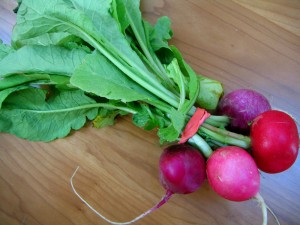
Eating locally is a way of giving back to the Earth.

Fresh radishes from a Boulder farm

1. Eat closer to home. The average American bite of food travels 1500 miles to reach the table. That’s an astronomical amount of fossil fuel used just in transporting the food, to say nothing of growing and packaging it. Join a local CSA (community-supported agriculture), or shop at farmers’ markets. For more info, see scientist and Earth lover David Suzuki’s page on food and our planet.

2. Eat organic. We all know it’s better for human health, and for the same reasons it is better for soil, water, and air health too. Eating organic keeps the soil, the foundation of life, healthy and safe. It keeps synthetic nitrogen out of waterways and prevents carbon emissions from entering the atmosphere. What’s good for your body is good for the Earth. Give back to Earth by giving back only substances that the Earth enjoys.

3. Thank your food. Look, really look, at the plants and animals on your table. Notice each one. Imagine the rice or oat or wheat grasses waving under the sun, the carrots developing underground, the strawberries ripening on the vine. If you eat meat, think about every animal. Picture the cow grazing (and if you eat cows, eat free-range, grass-fed, not corn-fed ones), the chicken scratching (make sure they led happy lives outside of cages), the fish swimming. Think about the life labor that the hen put forth in making an egg, the goat her milk.

Gratitude is a time-honored way of reciprocating. Thank each animal, each plant, every time, for the gifts of their lives and their bodies. Christians call it saying grace. Buddhists call it eating mindfully. All of us can thank the plants and animals. Our lives depend on them. Literally.
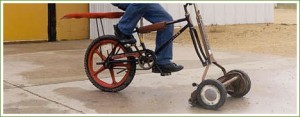
Using a manual rather than gasoline mower reduces pollution, giving back to the Earth.

Bike-powered mower, from ecogeek.com

4. Power down your lawn care. A gasoline-powered lawn mower, gallon for gallon, emits more air pollutants than a car. Figured conservatively, even after new 2012 EPA lawn mower emissions standards, a mower emits as much pollution as four cars.

And don’t even think about leaf blowers. The noise disturbs humans and birds, they pollute in the same way lawn mowers do, and they disperse into the air millions of microorganisms that were intended to be left in the dirt to compost and renew, such as mold, dust, and animal feces.

If you have to use a mower, use a manual push mower. If your lawn is too big for a push mower, ask yourself, Do I really need this much grass?

5. Plant natives in your yard or in containers on your patio. Locally native plants, trees, and flowers evolved in community with each other and in tandem with the climate and soils in your area. They can handle the heat or the cold or the humidity or wind of your particular place. When you plant natives, you are expressing appreciation for your bioregion, seeking to live in harmony with it. Planting natives invites the local insects and pollinators back to your area, which in turn brings the birds and animals. Planting natives is a way of saying thank-you to your place.

6. For body care, stick to biodegradable. Pick your teeth the old-fashioned way, with wooden toothpicks instead of the tiny plastic picks and brushes that many dentists’ offices are passing out to their patients. For skin and hair care, avoid products with a chemical scent, which likely means they’re depositing synthetic chemicals on both you and your environment. Find products with the label certified biodegradable, which indicates they have been tested and met biodegradable standards.

7. Teach your children reciprocity. Even small children understand fairness. No one wants to get the short end of the stick. Teach your children to give back when they receive something. Practice it yourself. If each of us truly gave as much as we took, the world would change.
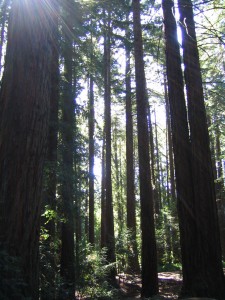
Urban redwoods in Joaquin Miller Park, Oakland, CA

8. Thank a tree. As you walk down your street, notice one tree or plant every day. Thank it for making oxygen. Your life depends on it. Go one step further in appreciating trees by stopping junk mail.

9. Work to reduce pesticide use in your neighborhood. We all know about pesticide use in agriculture, but pesticides are used at an equivalent rate on suburban lawns. What about the playing fields at your local school? (Fungicides and herbicides are pesticides too.) Children absorb more pesticides per pound of body weight than do adults, according to the National Academy of Sciences. For more info, see the “Lawn Care” page at Beyond Pesticides.

10. Refuse overpackaging. Say “no thanks” to foods or supplements prepackaged in tiny portions. Every piece of plastic ends up in a landfill—or on beaches or becoming part of the enormous swirling toilet bowls of plastic in our oceans, endangering the lives of sea creatures. Say no to those individually wrapped slices, those one-serving containers. Buy your food from farmers’ markets when you can (it’s local too!). Make it part of your lifestyle to reduce your use of plastic or go plastic free altogether.

11. Host a zero-waste party. It’s easier than you think. Paper plates and cups can be composted in municipal composting processes, and cornstarch-based compostable flatware and cups are now easy to find. Or visit your local thrift store and buy a few dozen older plates and forks and wash them afterward, then donate them back after the party’s over. Same with glasses and cloth napkins. I spent $25 at a thrift store for my last dinner party and then got credit afterward for the same amount in donation. That thrift store benefits a nonprofit group, so when they sell their merchandise twice they raise even more money.

12. Volunteer for a cleanup or restoration project in your area. You get the pleasure of meeting like-minded neighbors in addition to the joy of giving back to the Earth in a very direct and immediate way. The sense of camaraderie and a deep-seated satisfaction after a half day of work keeps restoration volunteers coming back. They look forward to having more fun!

Posted in nature | Tagged , , , , , , , , , , | Comments Off on 12 ways to give back to the Earth